Long-run evidence
This page records nonlinear evidence available through commit adcc714, including
30-minute-budget long runs, double-Harris validation promotion/convergence
bundles, and deliberately skeptical interpretation. These runs validate long
integration, checkpointing, media, nonlinear budget gates, and bounded
current-sheet response diagnostics. The latest GPU campaign closes the
Rutherford production-promotion response gate, but it does not yet
demonstrate Rutherford algebraic scaling across amplitudes or plasmoid onset.
Production automation lane
The current production-campaign lane is generated, not launched, by default:
python tools/run_nonlinear_production_campaign.py \
  --outdir outputs/campaigns/nonlinear_production_campaign \
  --dry-run
This writes production_campaign_manifest.json and run_commands.sh with exact
Rutherford and double-Harris commands for the duration, convergence, seed-QI,
sheet-width/aspect, eta/Lundquist, fixed-scale movie, and promotion gates. The
manifest itself is validation-level planning evidence only. Running the lane
requires the explicit --execute flag plus timeout controls, and production
wording remains blocked unless the Rutherford target completes, the promotion
report passes, and the final --allow-production-claim --max-steps 0 refresh
command succeeds. The 2026-05-25 GPU campaign satisfied those Rutherford
promotion gates for commit adcc714.
Latest passing Rutherford production-promotion run:
outputs/campaigns/release_long_gpu_20260525_203421_n128_t240_periodic_rutherford_adcc714
Key promotion metrics from the run:
target duration:
t_end = 240.0,terminal_step = 12000,target_step = 12000;history samples:
123;reconnecting-flux amplification:
8.359281934515764;Rutherford-width amplification:
2.8912422822232937;promotion reports:
rutherford/validation.json,rutherford/promotion/validation.json, andproduction_campaign_manifest.jsonall pass.
Reproducible command sequence
The completed duration run used the restartable production executor:
mhx campaign rutherford-plan-production \
  --outdir outputs/long_runs/rutherford_96_dt005_full_20260512 \
  --nx 96 --ny 96 --dt 0.05 --target-saved-frames 200 \
  --max-walltime-hours 0.5 \
  --seconds-per-step-estimate 0.04 \
  --checkpoint-interval-minutes 5 \
  --preemption-margin-minutes 2

mhx campaign rutherford-execute \
  outputs/long_runs/rutherford_96_dt005_full_20260512 \
  --max-steps 45802 --movies \
  --max-relative-energy-growth 1e-6 \
  --max-divergence-linf 1e-8
The active nonlinear-budget run used the multi-mode reduced-MHD state from
nonlinear.py:
from mhx.benchmarks.nonlinear import write_nonlinear_energy_budget_validation

write_nonlinear_energy_budget_validation(
    "outputs/long_runs/nonlinear_budget_96_dt005_steps20000_20260512",
    shape=(96, 96),
    resistivity=2e-2,
    viscosity=2e-2,
    dt=5e-3,
    steps=20000,
    save_every=50,
    max_budget_residual=5e-4,
    max_relative_energy_growth=1e-8,
)
The current-sheet long replay uses the periodic double-Harris initializer from
equilibria.py
and the scalable base-vs-seeded benchmark in
current_sheet.py:
mhx benchmark double-harris-long-run \
  --outdir outputs/long_runs/periodic_double_harris_seeded_128_t100_20260512 \
  --nx 128 --ny 128 --t-end 100 --save-every 200 --fit-stop 10 --no-movies
Rutherford-duration executor run
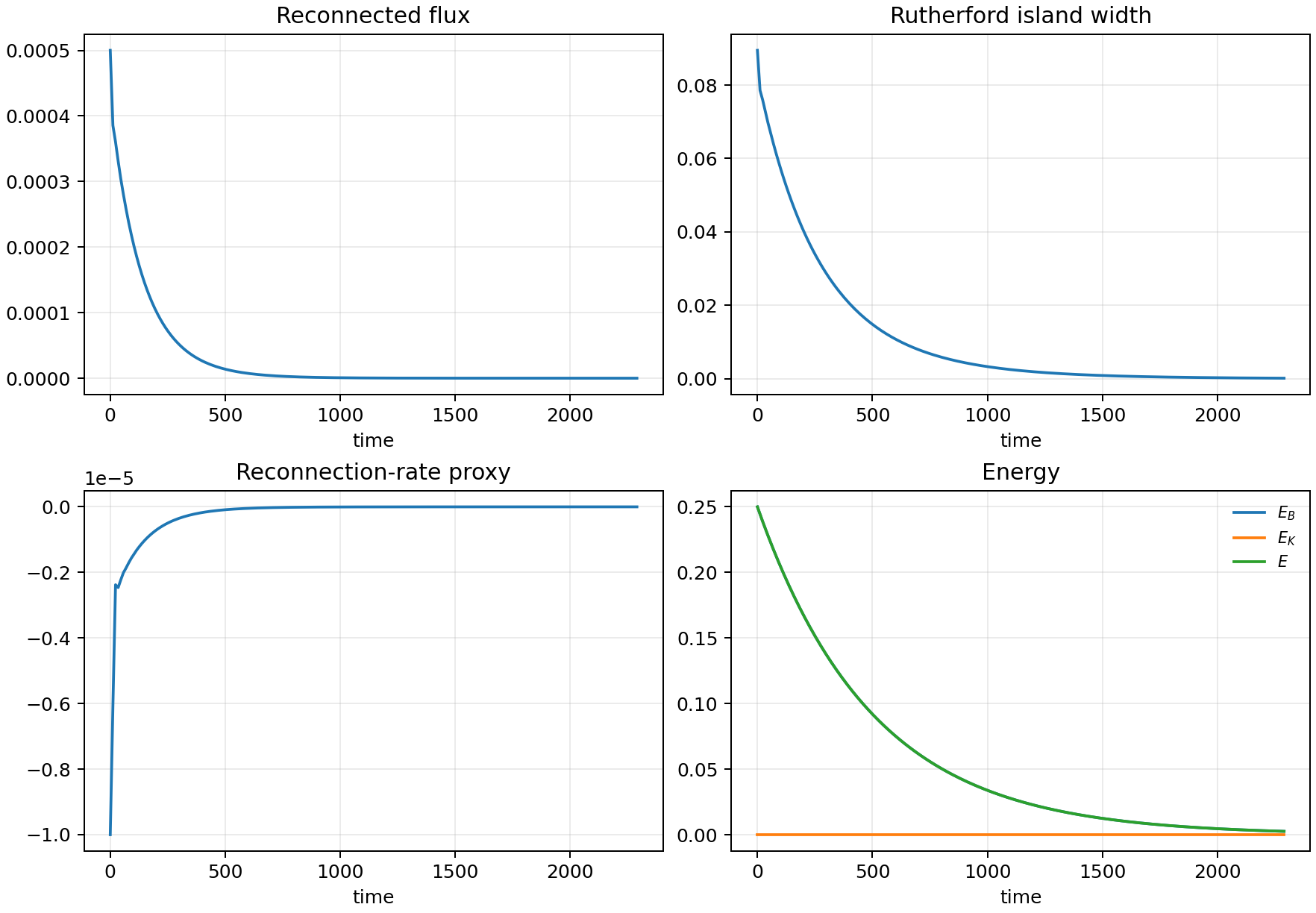
The 96×96 Rutherford-duration executor run completed the configured duration
target under the executor schema available when it was generated. It remains a
validation-level bundle unless rerun or upgraded with current history keys and a
passing promotion-readiness report.
Quantity |
Value |
|---|---|
RK4 steps |
45,802 |
final time |
2290.1 |
saved samples |
202 |
policy e-folds |
30 |
elapsed walltime |
888.6 s |
executor gates |
passed; promotion gates not claimed |
final/initial reconnecting-flux proxy |
|
final/initial island-width proxy |
|
final/initial total energy |
|
max kinetic energy |
|
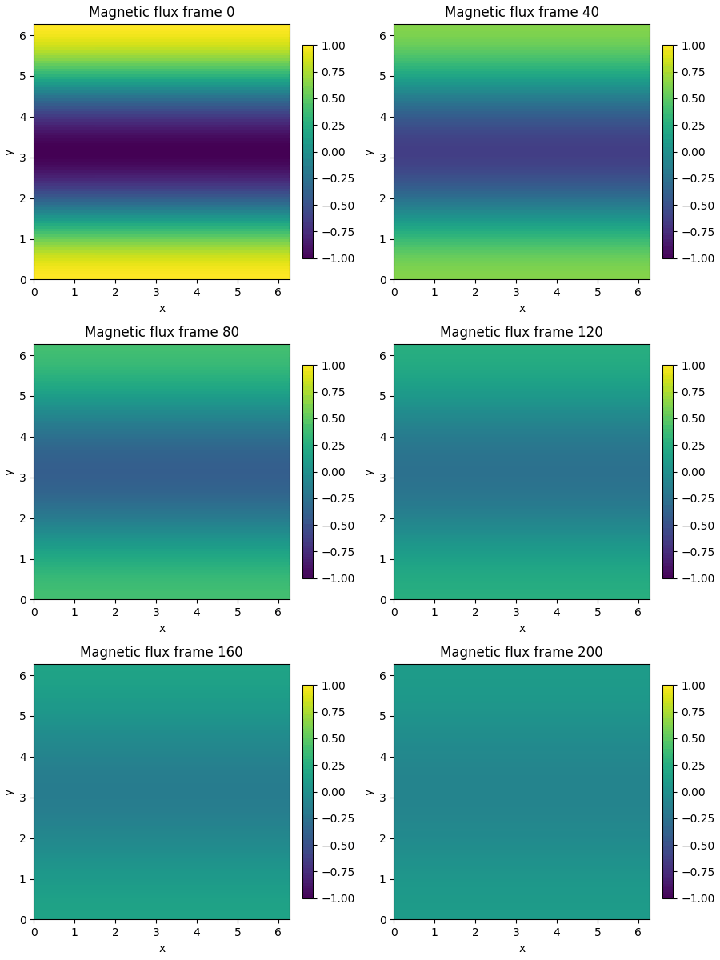
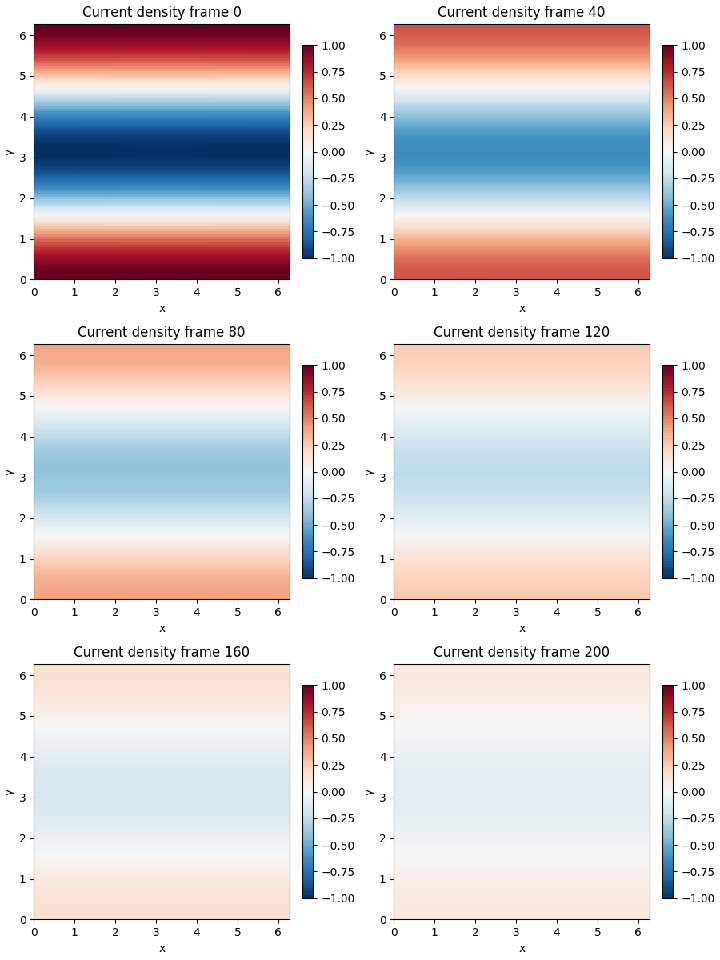
The fixed-scale movies show the same conclusion visually: the periodic cosine field diffuses away rather than forming growing islands.
Skeptical interpretation
This is strong evidence for the restartable production-executor path, not for a promotion-ready production physics claim:
the full target step count is completed in one restartable bundle;
checkpoint state, checkpoint metadata, resume plan, manifest hashes, fixed-scale movies, and history schema are written;
finite-history, energy, divergence, checkpoint, and movie gates all pass for that execution bundle.
the archived history predates the newer current-sheet geometry and refined X/O-count promotion keys, so it is not sufficient for today’s promotion gate.
It is not evidence for Rutherford growth. The reconnecting-flux proxy, island-width proxy, current, and total energy all decay, and the kinetic energy stays nearly zero. The current periodic cosine initial condition is therefore a long dissipative integration test, not a tearing-growth experiment.
Current-schema Rutherford executor rerun
A current-schema 96×96, dt=0.05 rerun was executed with the same duration
target so the long-run bundle includes the newer current-sheet geometry and
refined critical-point count histories:
mhx campaign rutherford-plan-production \
  --outdir outputs/campaigns/rutherford_current_schema_96_dt005_20260517_161235 \
  --nx 96 --ny 96 --dt 0.05 --target-saved-frames 200 \
  --max-walltime-hours 0.5 \
  --seconds-per-step-estimate 0.04 \
  --checkpoint-interval-minutes 5 \
  --preemption-margin-minutes 2

mhx campaign rutherford-execute \
  outputs/campaigns/rutherford_current_schema_96_dt005_20260517_161235 \
  --max-steps 45802 --movies \
  --max-relative-energy-growth 1e-6 \
  --max-divergence-linf 1e-8

mhx campaign rutherford-promotion-check \
  outputs/campaigns/rutherford_current_schema_96_dt005_20260517_161235 \
  --convergence-dir outputs/campaigns/rutherford_current_schema_96_dt005_20260517_161235/evidence_20260517_response_gate/convergence_n16_24 \
  --convergence-dir outputs/campaigns/rutherford_current_schema_96_dt005_20260517_161235/evidence_20260517_response_gate/convergence_n18_26 \
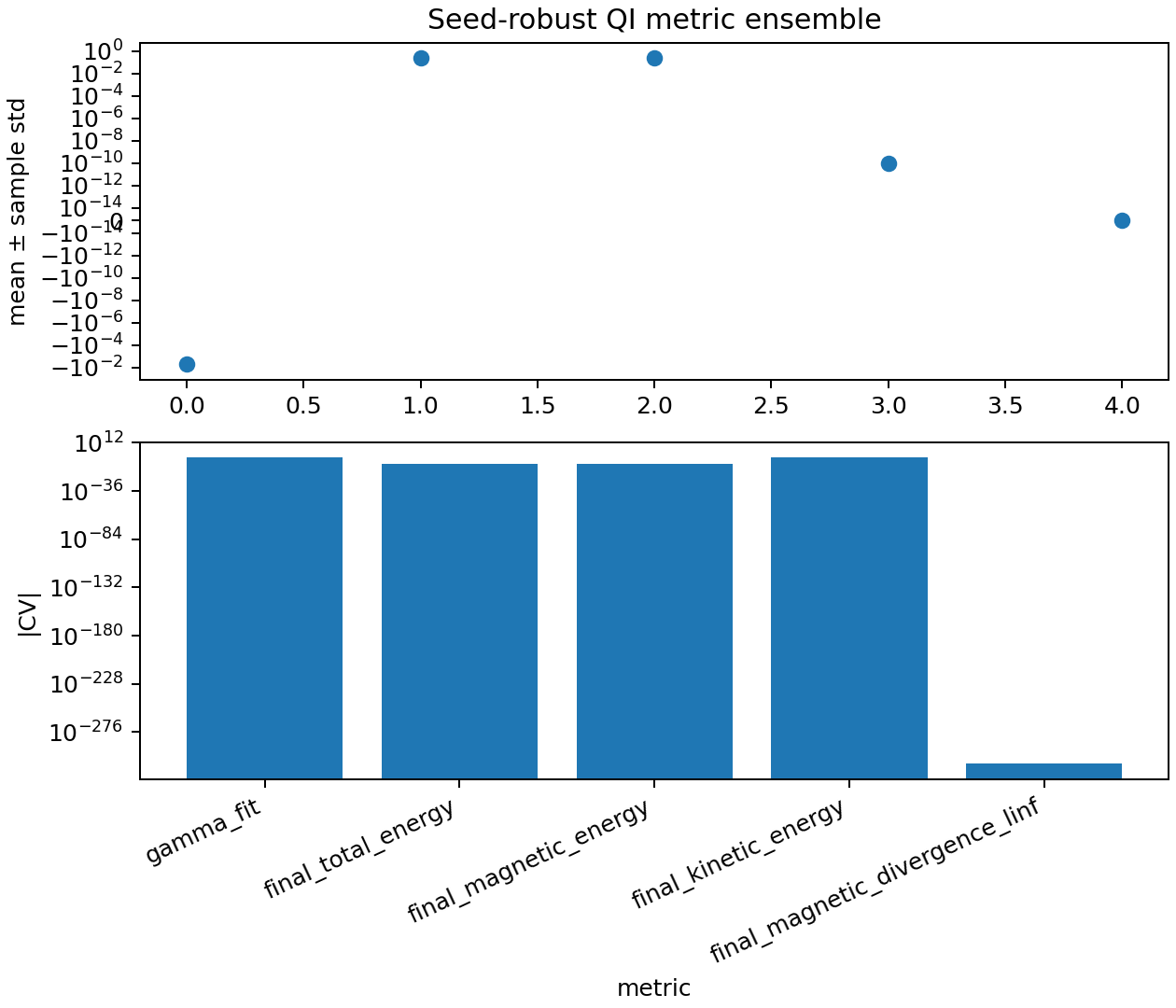
  --seed-qi-dir outputs/campaigns/rutherford_current_schema_96_dt005_20260517_161235/evidence_20260517_response_gate/seed_robust_qi_n16 || true
Quantity |
Value |
|---|---|
RK4 steps |
45,802 |
final time |
2290.1 |
saved samples |
202 |
execution gates |
passed |
promotion gates |
failed: no positive reconnecting-flux/island-width response |
convergence evidence |
two small validation bundles passed and were checksummed |
seed-QI evidence |
one small validation bundle passed |
reconnecting-flux amplification |
|
island-width amplification |
|
max X/O counts |
|
current-sheet aspect proxy |
|
final/initial total energy |
|
max energy-budget residual |
|
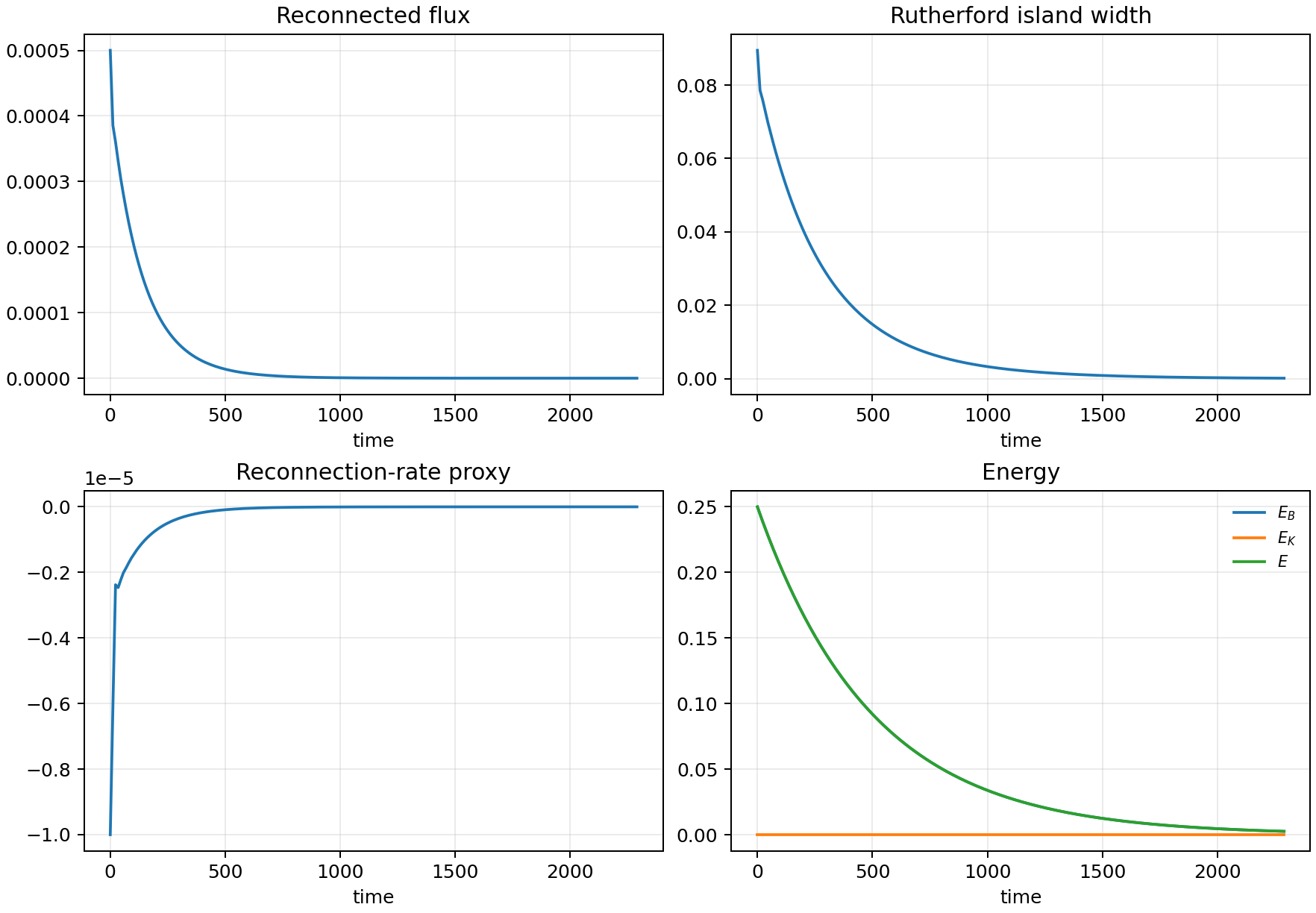
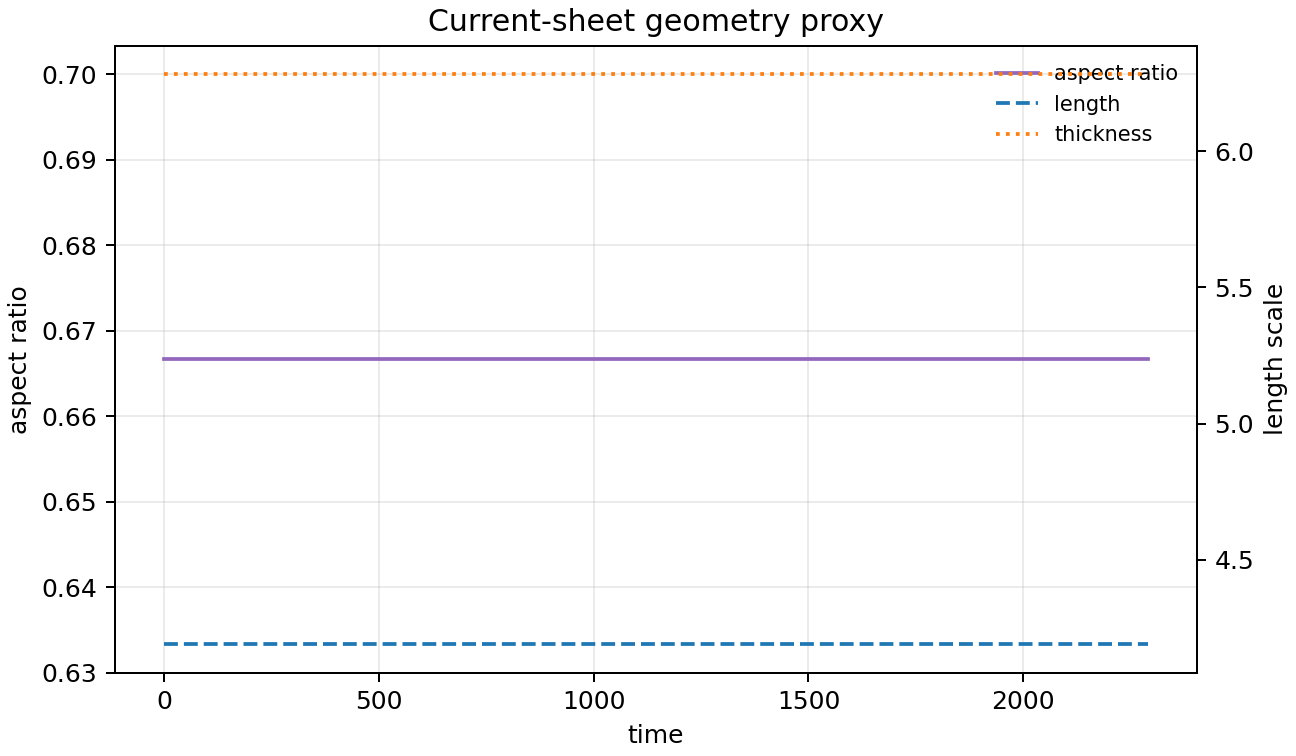
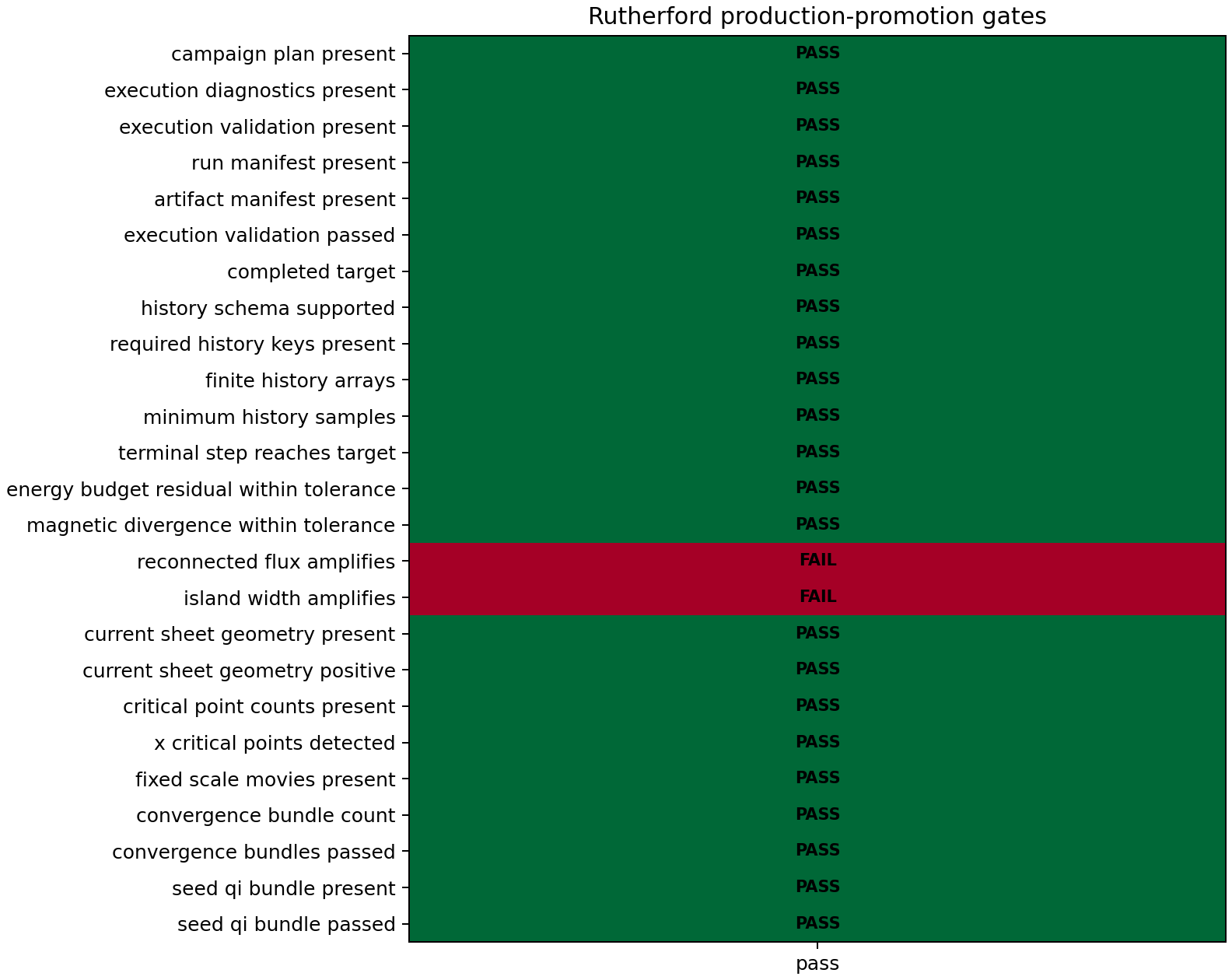
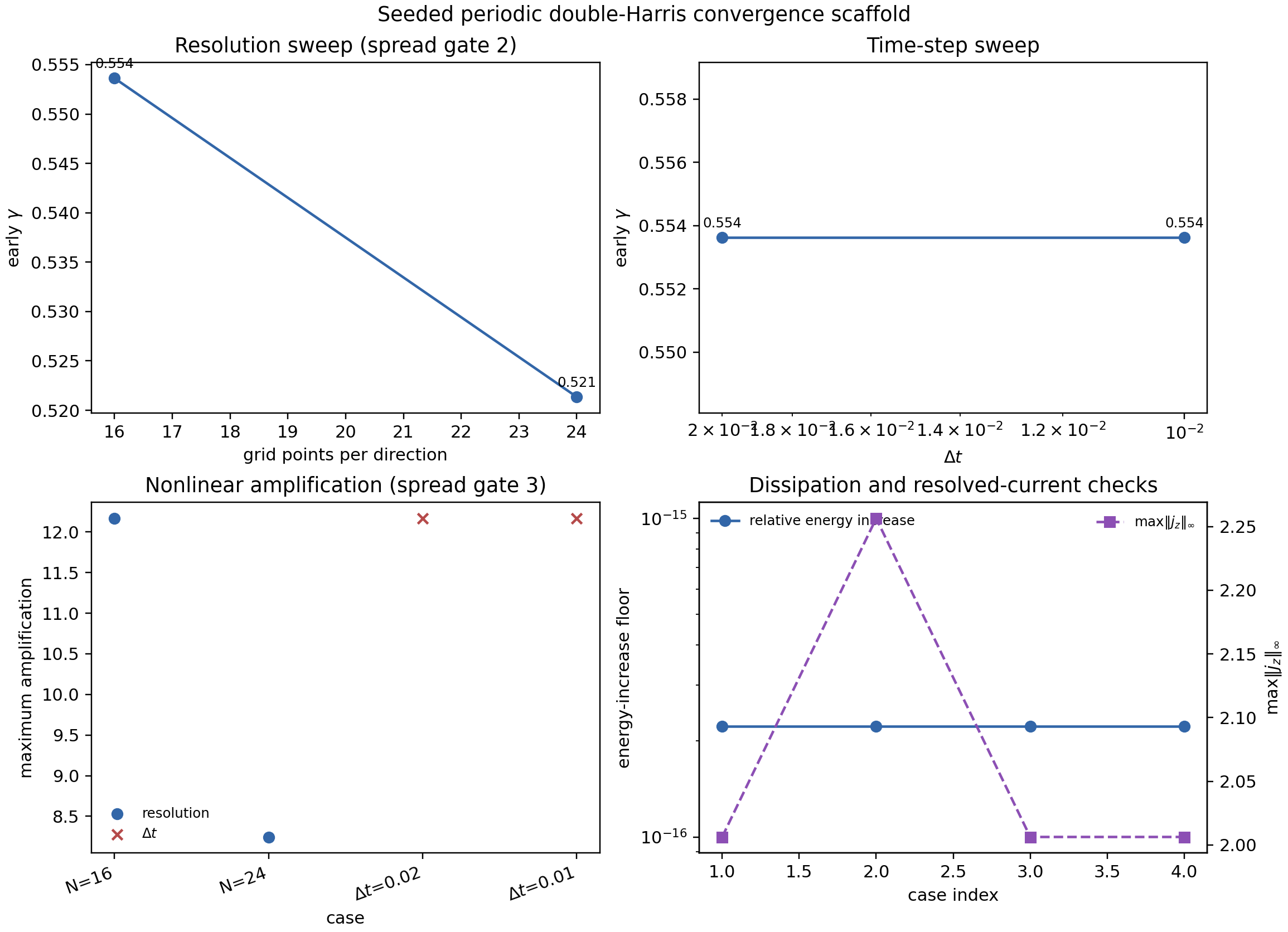
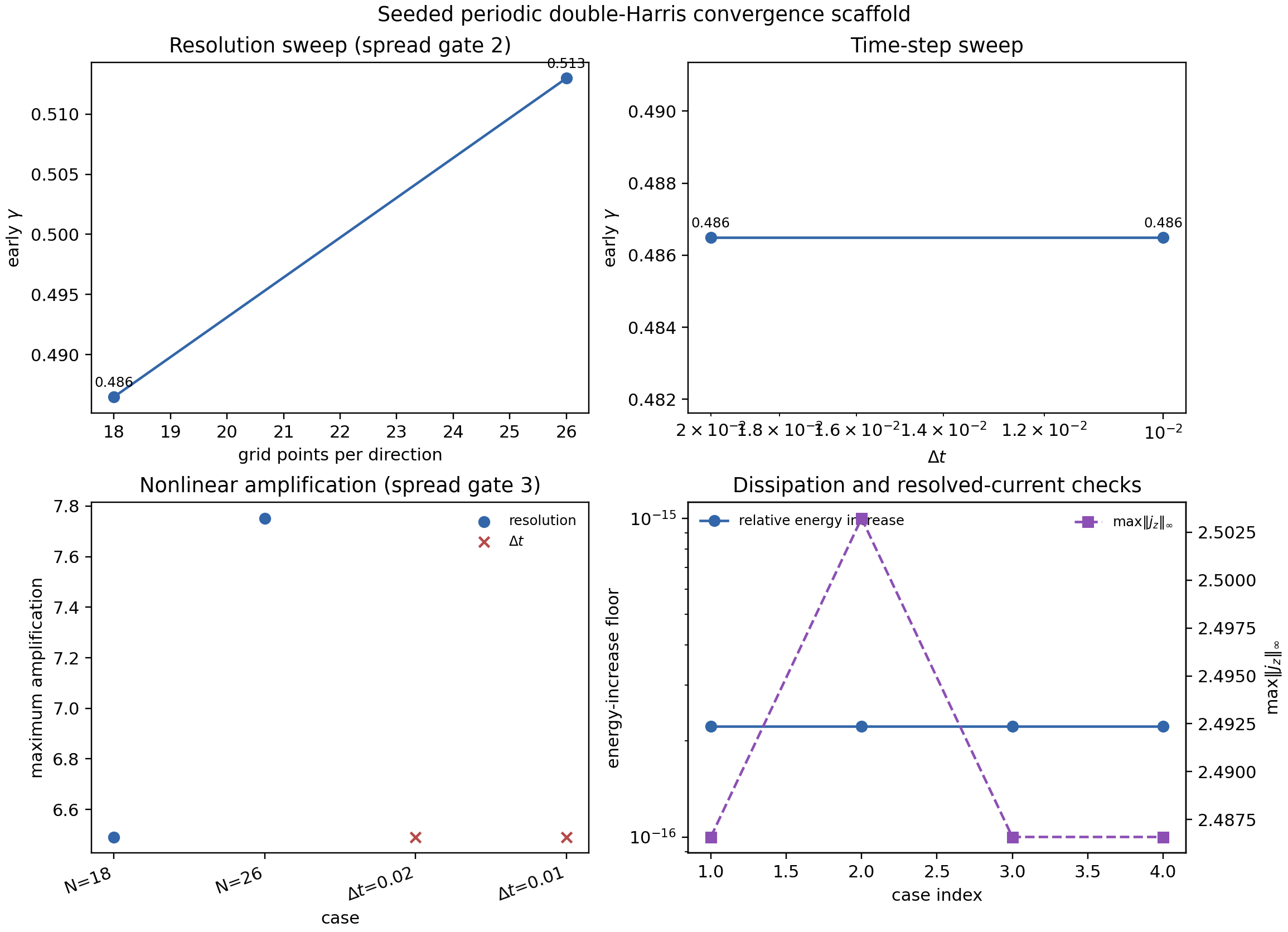
The important result is negative but useful: the executor now writes every history key required by the current promotion gate. The promotion gate also requires positive reconnecting-flux and island-width amplification, so this purely dissipative duration-complete run remains validation evidence even after convergence and seed-QI bundles are attached.
Active nonlinear energy-budget run
The second run uses a genuinely nonlinear multi-mode initial condition with a large ideal-to-full RHS ratio. It checks the periodic reduced-MHD budget
Quantity |
Value |
|---|---|
grid |
|
RK4 steps |
20,000 |
final time |
100.0 |
saved samples |
401 |
nonlinear RHS ratio |
0.994 |
relative energy drop |
0.985 |
max relative budget residual |
|
gates |
passed |
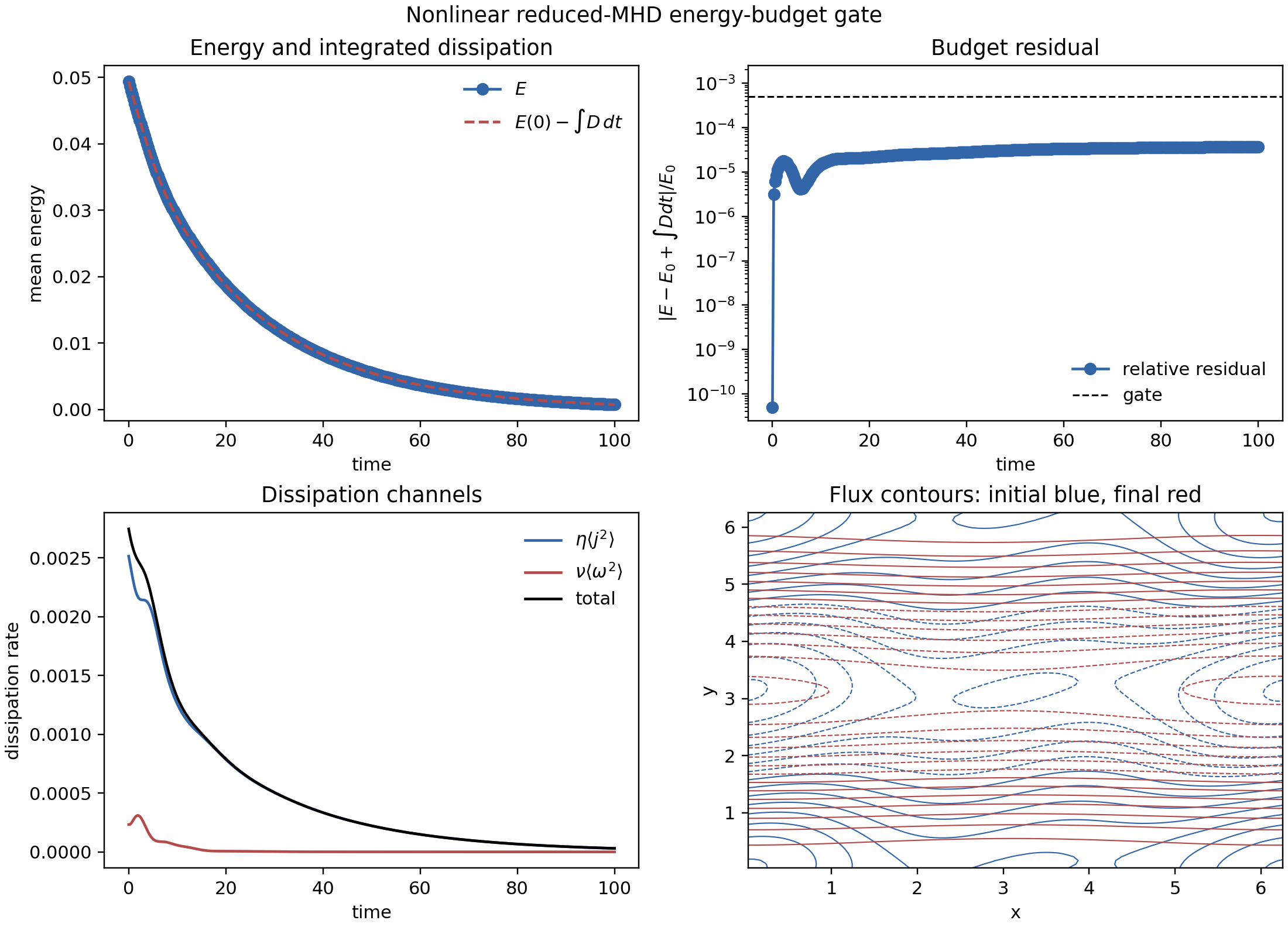
This is good evidence that nonlinear Poisson brackets, spectral current, dissipation signs, and RK4 integration remain coherent over a substantially longer run than the FAST CI defaults.
Seeded double-Harris long replay
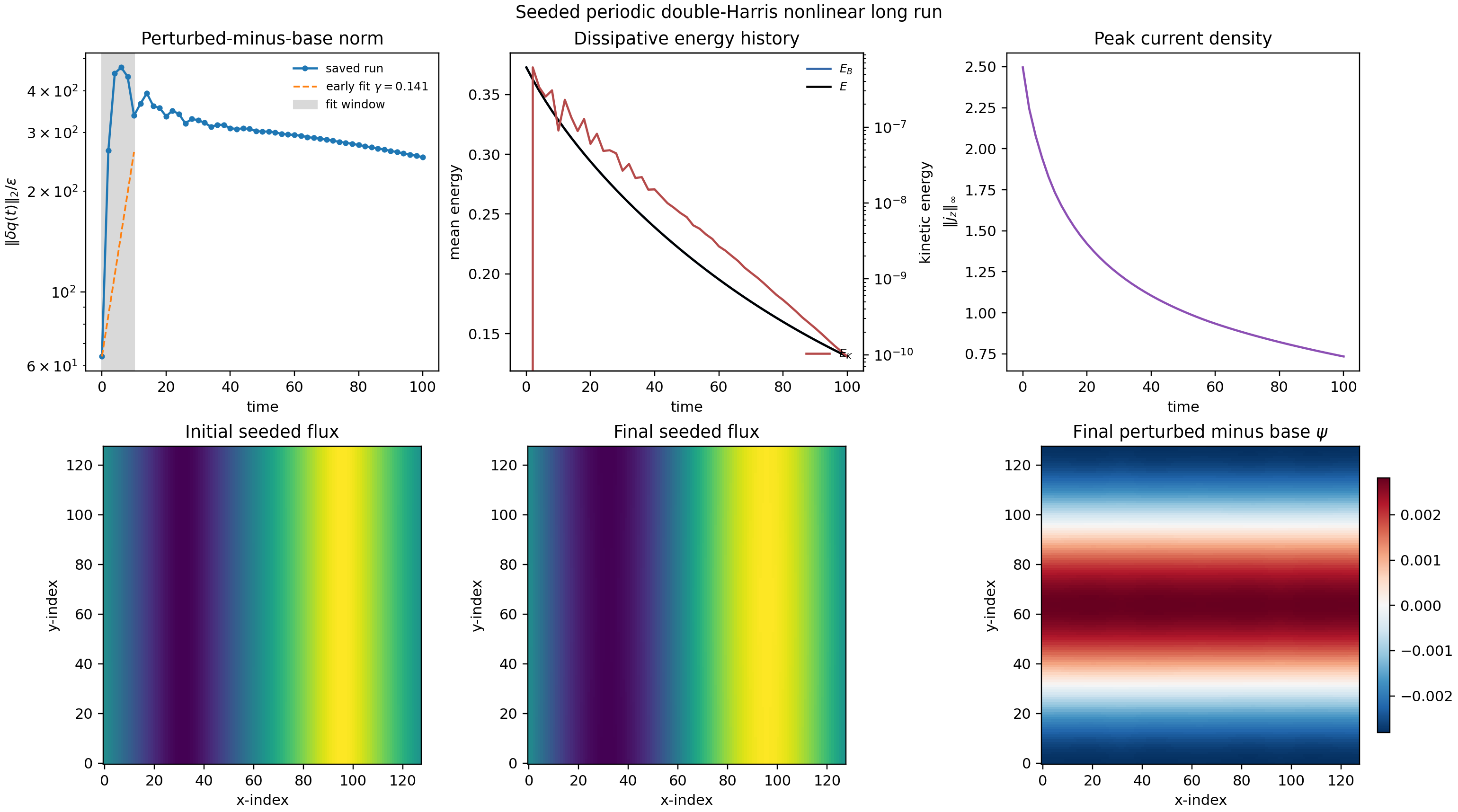
The new periodic double-Harris run is the first long nonlinear current-sheet replay in this rebuild that shows an early instability-path response rather than pure decay of a stable cosine equilibrium. It advances a base run and a seeded run on the same grid and measures
Quantity |
Value |
|---|---|
grid |
|
RK4 steps |
10,000 |
final time |
100.0 |
saved samples |
51 |
early fitted growth rate |
|
early amplification |
|
maximum amplification |
|
final/initial total energy |
|
max kinetic energy |
|
elapsed walltime |
|
gates |
passed |
Skeptical interpretation
This result is a real improvement over the earlier Rutherford-duration cosine run because the perturbation grows for several Alfvén times before saturating and relaxing. It still does not close a paper-grade reconnection claim: the kinetic energy remains very small, the current-sheet peak decays under the chosen resistivity/viscosity, and the run has no resolution, time-step, seed, or aspect-ratio sweep. The correct conclusion is that MHX now has a scalable nonlinear current-sheet validation lane suitable for those sweeps.
GPU-assisted double-Harris response rerun
After adding explicit response diagnostics, the double-Harris lane was rerun on
office with the system CUDA JAX backend (NVIDIA RTX A4000) to verify that a
longer validation run records more than a norm-only perturbation history. The
archived command was:
mhx benchmark double-harris-long-run \
  --outdir outputs/campaigns/growing_double_harris_gpu_96_t120_20260518_044120 \
  --nx 96 --ny 96 --t-end 120 --dt 0.01 --save-every 300 \
  --fit-stop 10 --min-max-growth-factor 2 --movies
Quantity |
Value |
|---|---|
grid |
|
final time |
120.0 |
saved samples |
41 |
early fitted growth rate |
|
early amplification |
|
maximum perturbation amplification |
|
dominant reconnecting-flux amplification |
|
Rutherford-width proxy amplification |
|
max detected X/O counts |
|
relative total-energy increase |
|
gates |
passed |
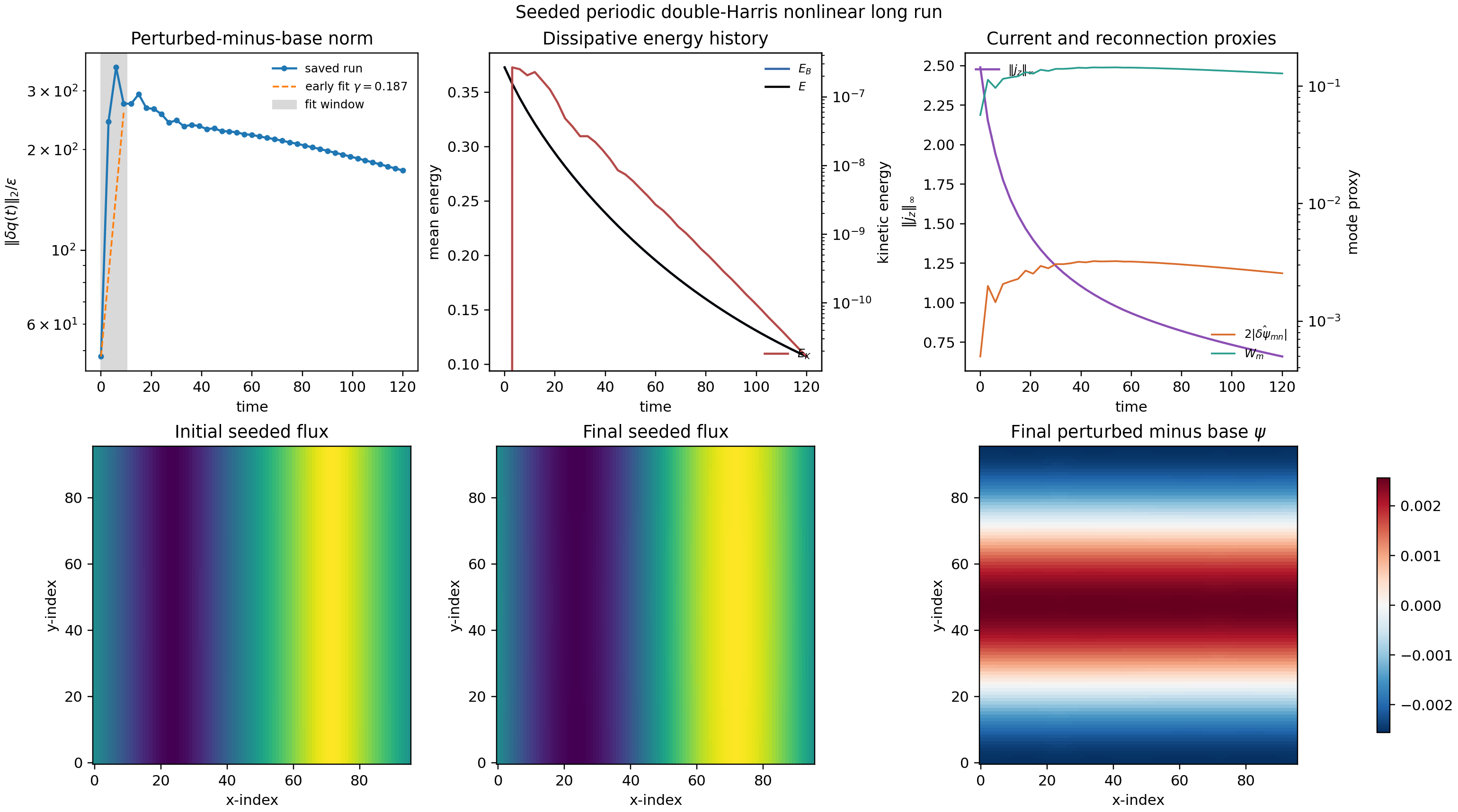
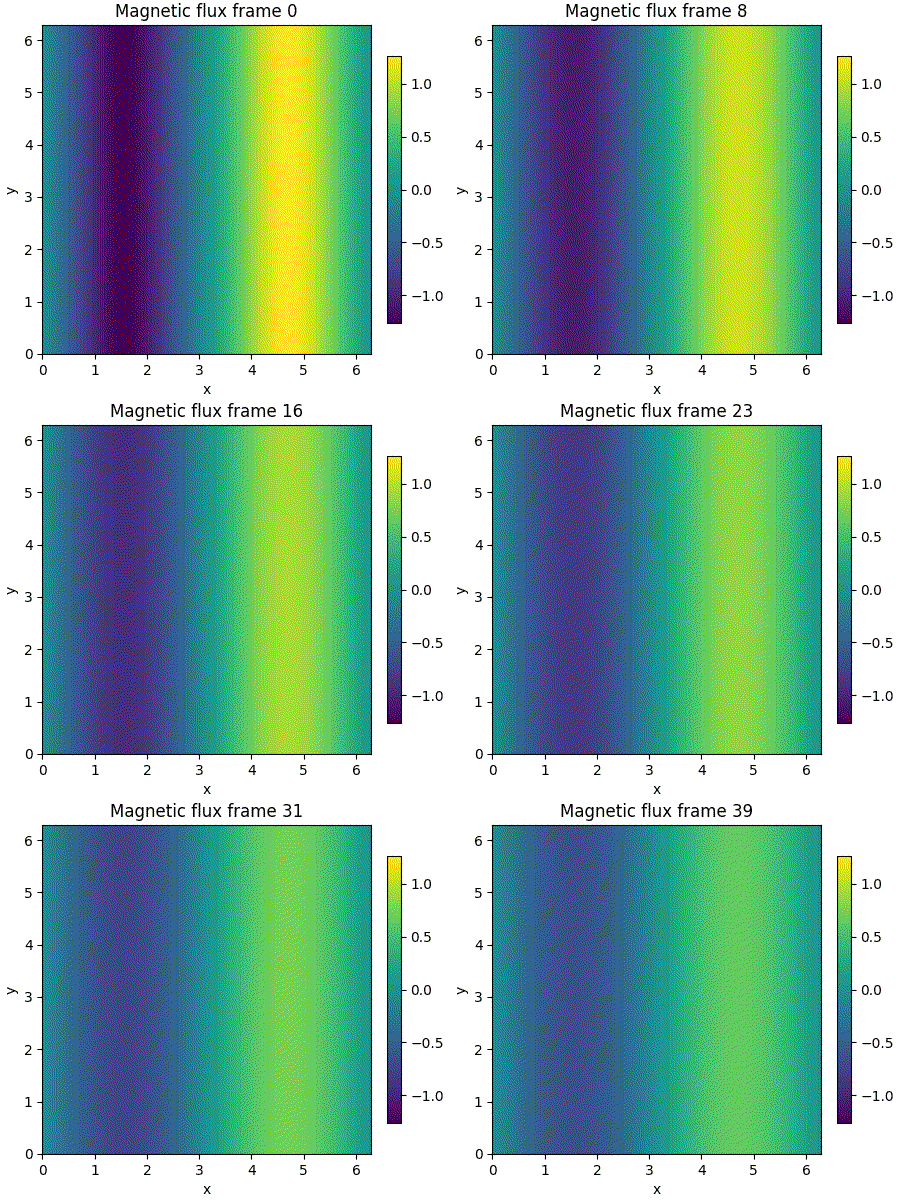
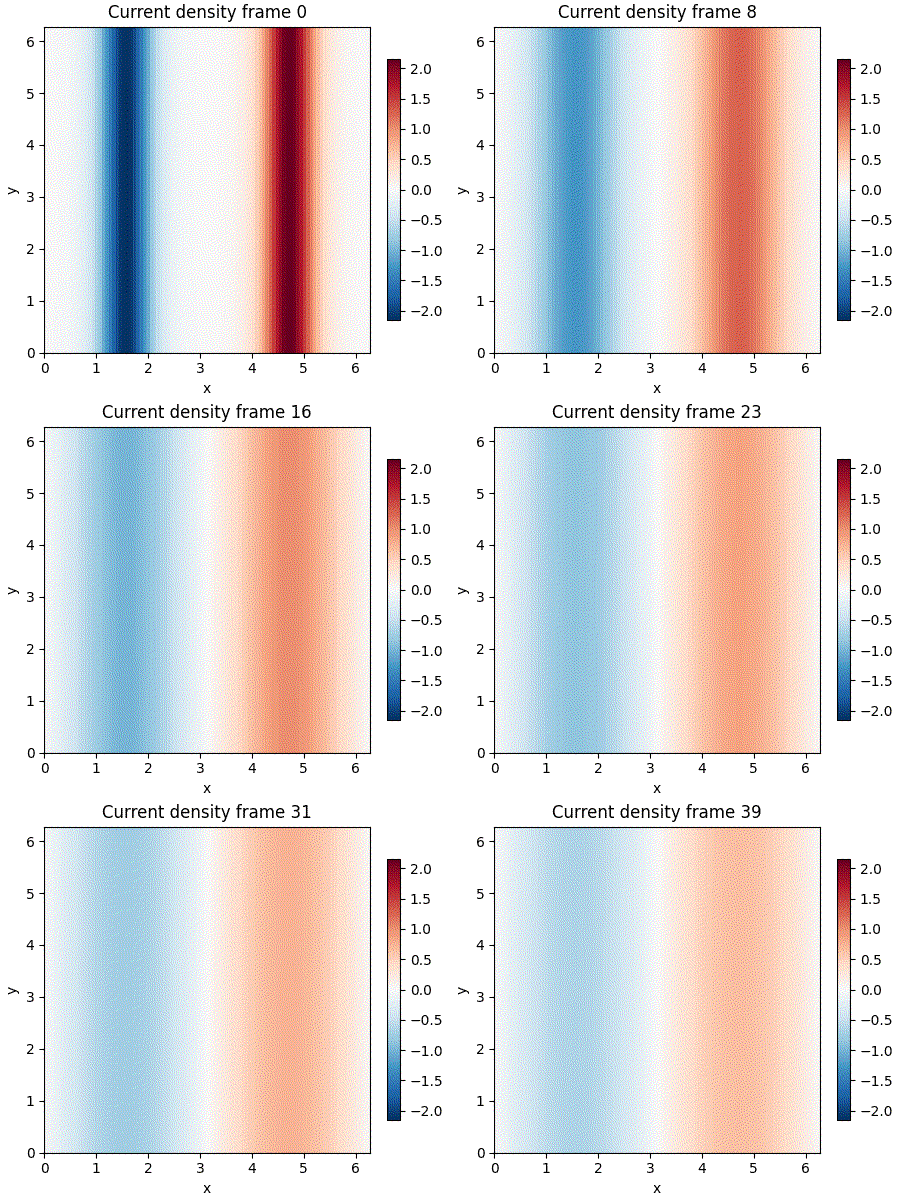
The skeptical read is unchanged: this is now stronger validation evidence because the response gate is explicit and positive, but it remains below production claim level until larger convergence, seed, aspect-ratio, and Lundquist-number sweeps close.
The new machine-readable promotion boundary for this lane is:
mhx benchmark double-harris-promotion-check \
  outputs/campaigns/growing_double_harris_gpu_96_t120_20260518_044120 \
  --convergence-dir outputs/benchmarks/periodic_double_harris_convergence
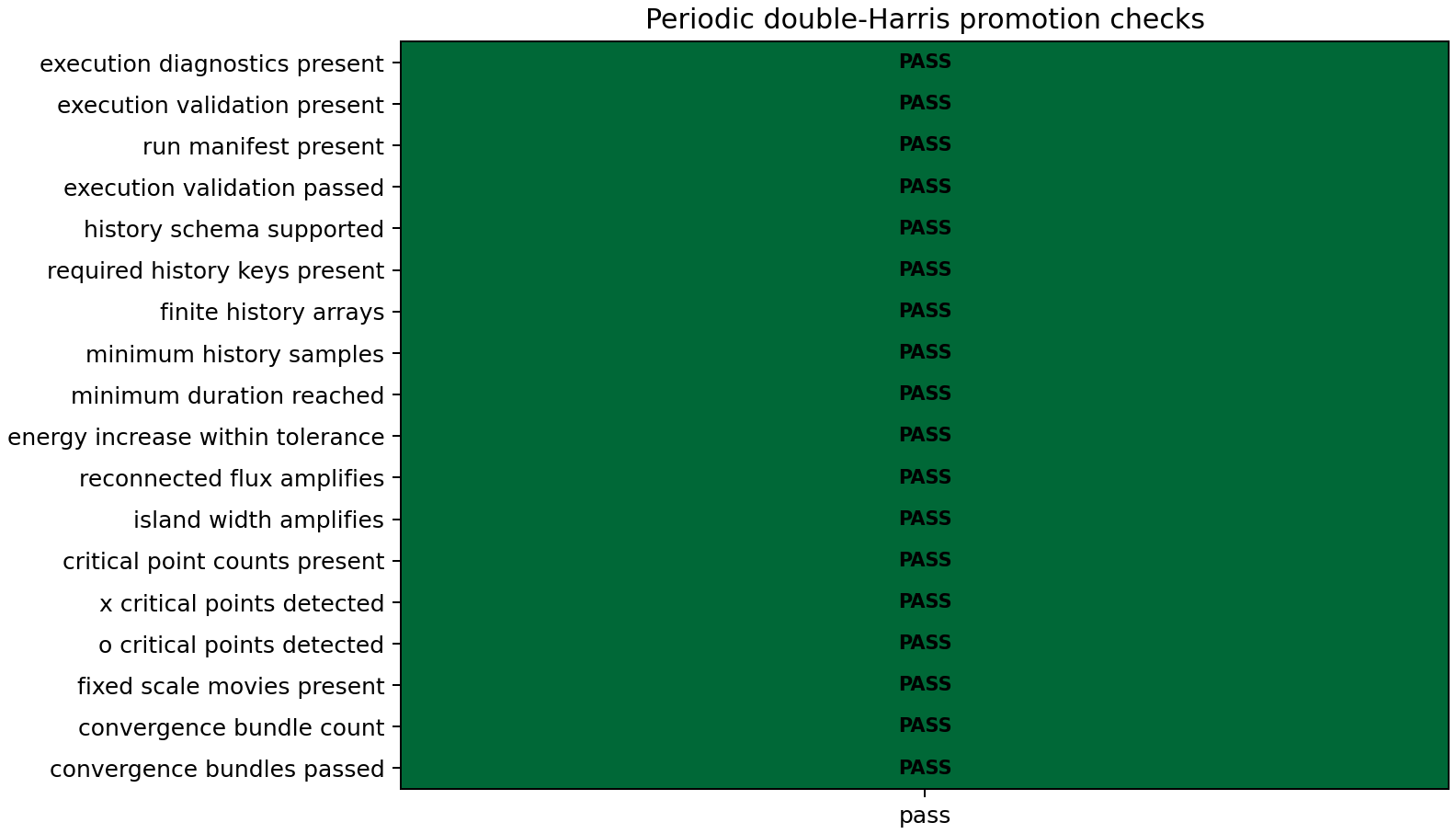
It writes promotion/promotion_readiness.json,
promotion/validation.json, promotion/figures/promotion_matrix.png, and an
artifact manifest. The report can promote a run to convergence-backed
validation media only; it deliberately cannot promote a run to production
Rutherford/plasmoid evidence.
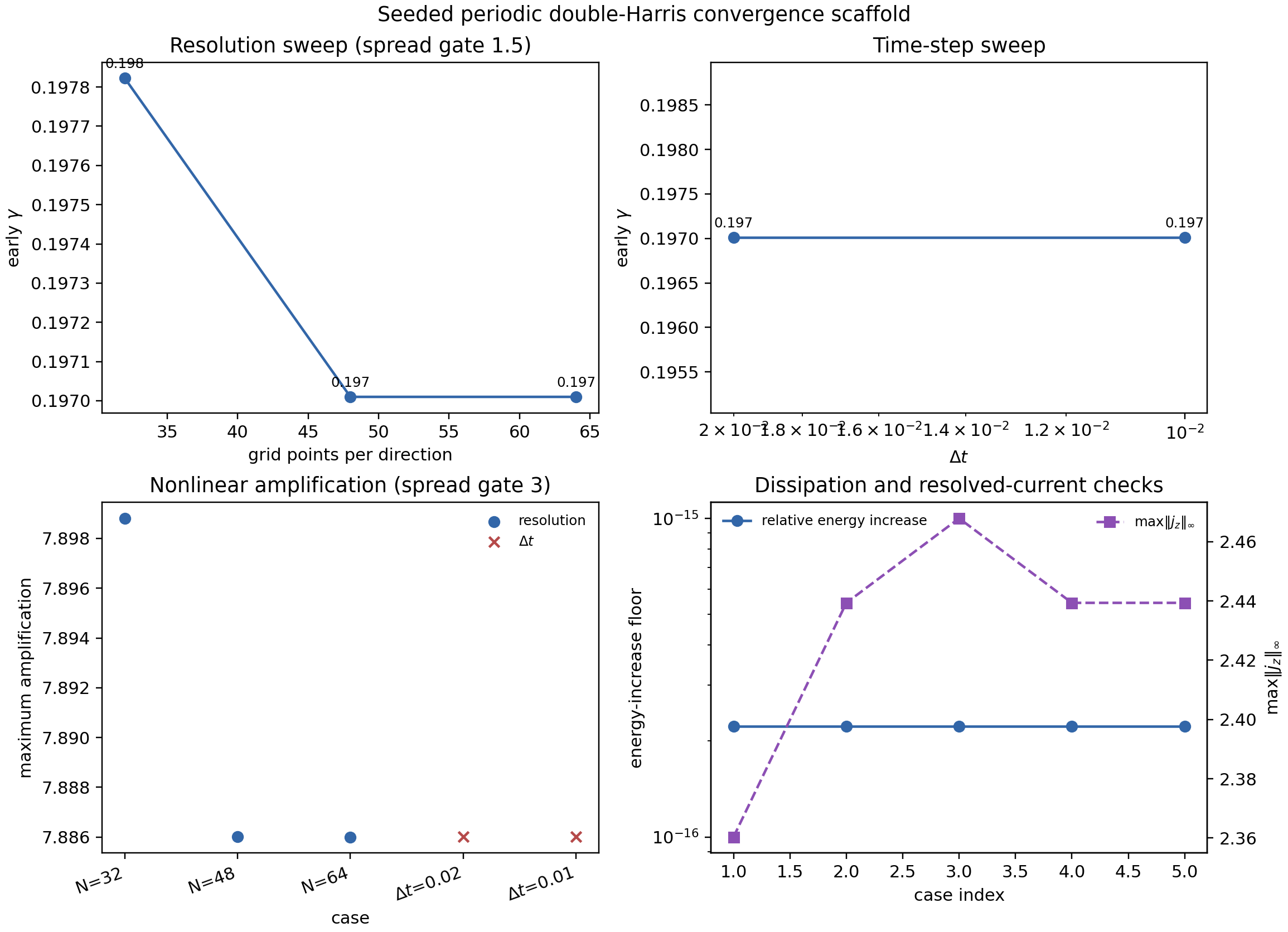
The same convergence code path was also run on a bounded GPU-assisted medium
sweep (32/48/64, t_end=16, dt=0.02/0.01). It passed with fitted growth
rates 0.1970–0.1978, maximum amplification 7.886–7.899, zero measured
relative energy increase, 0.41% resolution growth-rate spread, and
effectively zero time-step spread. This is no longer just a placeholder for a
future script: it is convergence-backed validation evidence while remaining
below production claim level.
Current claim boundary
These runs support:
long-run stability of the current reduced-MHD code path;
production-executor artifact correctness under a completed duration target;
nonlinear energy/dissipation-budget correctness for an active nonlinear state;
early seeded-growth response for a periodic double-Harris current-sheet replay;
duration-complete Rutherford production-promotion response at
128×128,t_end=240;double-Harris promotion and convergence reports as validation-only claim boundaries.
forced turbulent-reconnection readiness reports as validation-only proxy boundaries.
explicit evidence that execution-level validation and production promotion are separate gates.
These runs do not yet support:
Rutherford algebraic island-growth scaling across amplitudes;
plasmoid onset statistics;
Sweet-Parker reconnection-rate scaling;
publication-grade reconnection claims.
The next required physics step is no longer scaffolding. MHX now has double-Harris promotion/convergence validation evidence and a forced turbulent-reconnection readiness gate. To promote either family to production physics, extend the existing gates to larger resolution, seed amplitude/mode, sheet width/aspect ratio, Lundquist number, and duration sweeps, then promote only the figures whose scalings survive the full campaign.
Source anchors: