Validation media
The README only keeps a compact visual teaser. Detailed media context belongs here so each visual carries its claim level, source path, equations, and literature anchor. These assets are either generated from MHX validation gates or explicitly labeled theory schematics; none are production nonlinear plasmoid claims.
README media scope
The README should stay concise and show only landing-page media from
docs/_static/readme/: solver-generated Harris-sheet reconnection movies with
magnetic-flux contours, solver-generated reduced-MHD Orszag–Tang nonlinear
movies, and one compact Harris tearing layer sweep. Detailed benchmark command
catalogs, validation figure galleries, artifact inventories, CI output
checklists, production-run chunking details, neural-ODE outputs, plugin
walkthroughs, still figures, and scaffold comparisons belong in the
documentation pages where they can carry tolerances, commands, claim
boundaries, and maintenance context.
Residual-flux media policy
Public-facing double-Harris media must not rely on raw total-flux movies alone. The total magnetic flux is visually dominated by the static equilibrium sheet, so reviewer-facing media should pair any raw flux/current movie with at least one of:
a residual-flux movie or panel, \(\Delta\psi=\psi_\mathrm{perturbed}-\psi_\mathrm{base}\);
reconnected-flux and island-width proxy histories from the validation JSON;
a promotion or local gate summary that states
gate_ready,production_claim_ready, and the declaredclaim_level_if_passed.
The residual-flux view is visualization policy, not a stronger physics claim: it makes the seeded reconnecting response visible while the claim level remains bounded by the manifest and promotion gate. The standalone reviewer example that follows this policy is reproduced with:
MHX_EXAMPLE_FAST=1 \
MHX_EXAMPLE_OUTDIR_ROOT=outputs/reviewer/examples \
python examples/publication_double_harris_reconnection.py
It writes
outputs/reviewer/examples/double_harris_reconnection/figures/publication_double_harris_delta_flux.gif
alongside the raw flux/current movies, summary figure, manifest.json, and
validation.json.
At-a-glance media table
Asset |
What it shows |
Claim boundary and anchor |
|---|---|---|
|
Single-sheet Harris reconnection zoom from a |
Solver-generated validation media anchored to the Harris current-sheet and FKR tearing picture; the markers are diagnostic annotations, not separatrix-event labels or converged Rutherford/plasmoid evidence. |
|
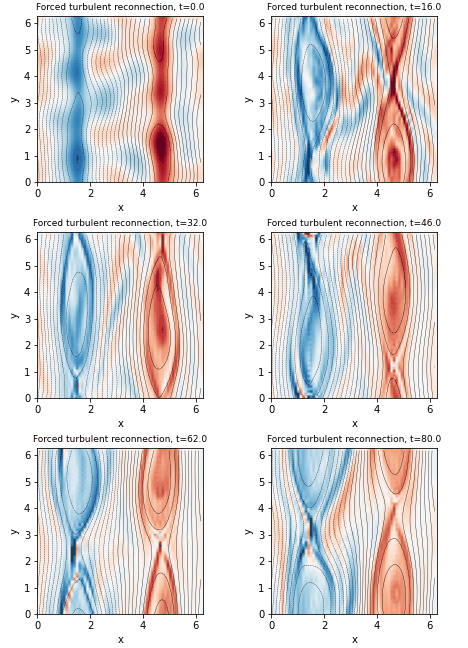
Full-domain periodic double-Harris view from the same bundle, showing residual current \(\Delta j_z\) across both sheets with total flux contours. |
Solver-generated validation media; useful for morphology QA before larger seed, duration, and resolution sweeps. |
|
|
Pedagogical 2-D reduced-MHD validation media anchored to turbulent-reconnection literature; not a 3-D LV99 fast-reconnection production test. |
|
|
Solver-generated nonlinear validation media; useful for turbulence morphology and current-sheet diagnostics, not converged turbulence statistics. |
|
Current-density filament formation from a |
Solver-generated validation media; nonlinear reduced-MHD cascade evidence, not a compressible shock-capturing full-MHD result. |
|
Vorticity roll-up from the same Orszag–Tang replay. |
Solver-generated validation media with energy, divergence, and high-wavenumber-fraction gates. |
|
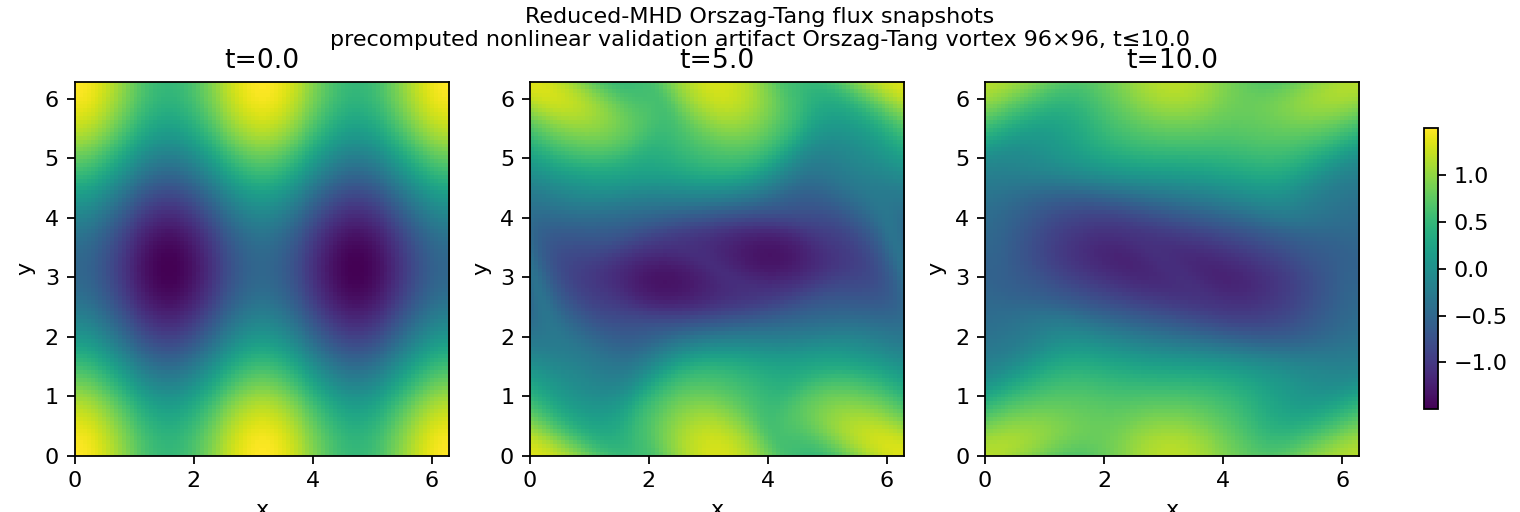
Flux-function deformation and dissipative mixing from the same Orszag–Tang replay. |
Solver-generated validation media; useful as a nonlinear example for new users. |
|
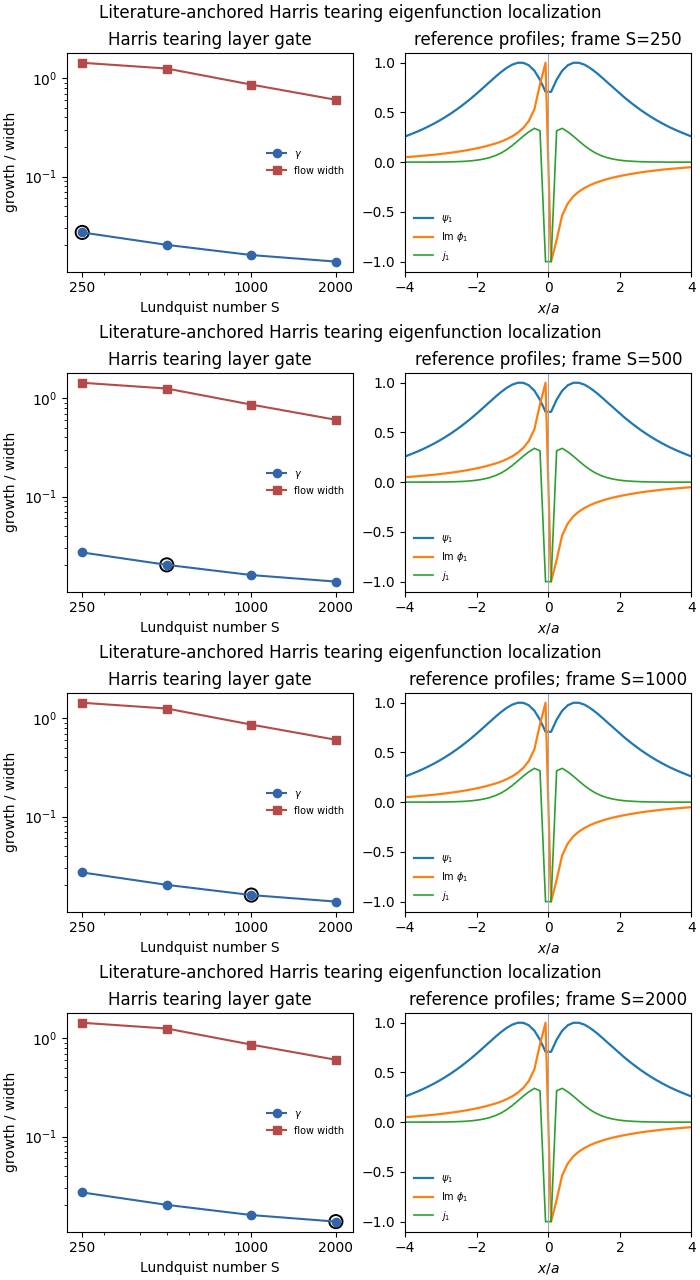
Direct Harris-sheet eigenproblem: growth decreases with \(S\) while the resonant flow/current layer narrows. |
Solver-generated validation media from |
|
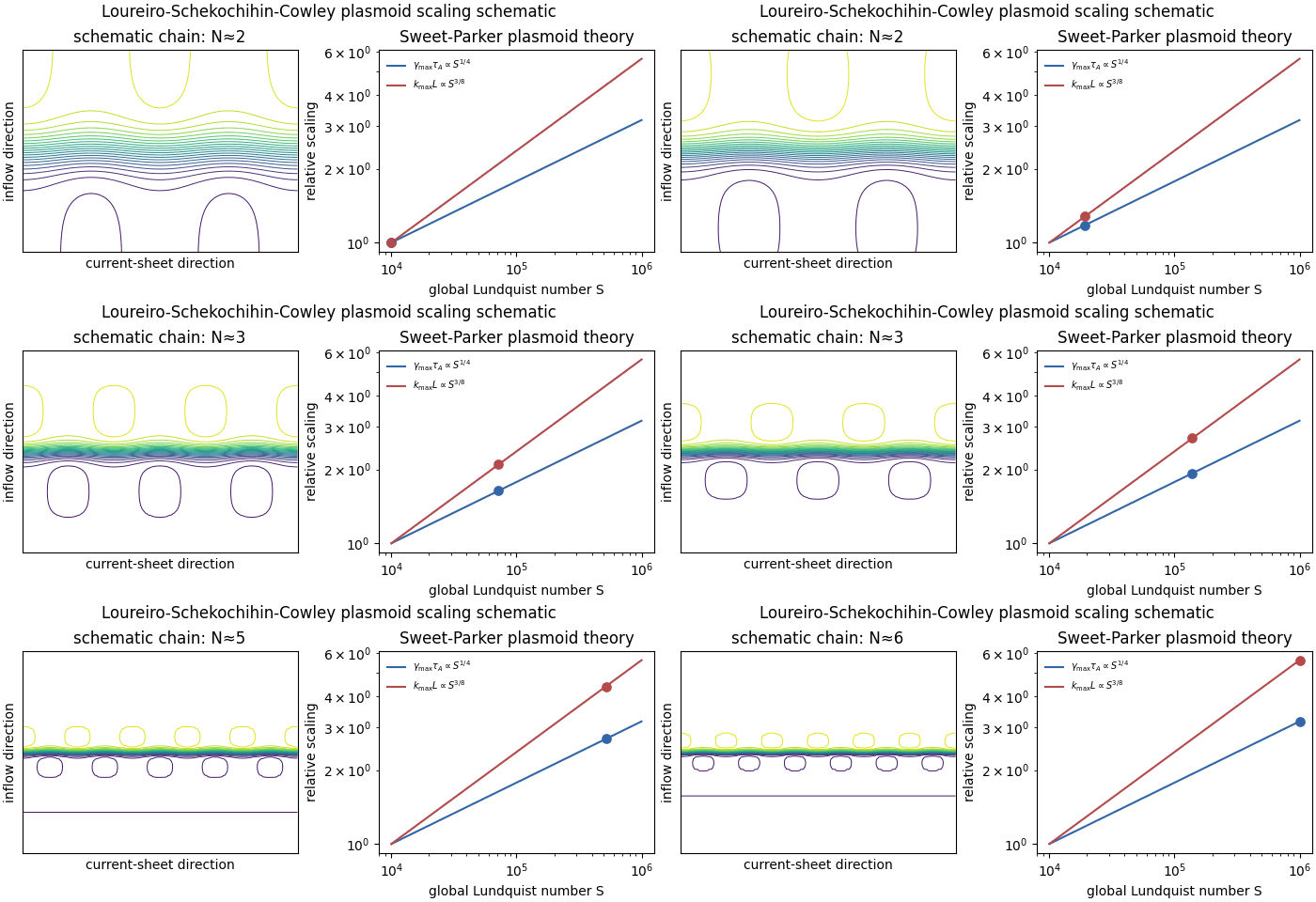
Schematic Sweet-Parker sheet fragmentation with \(\gamma_{\max}\tau_A\propto S^{1/4}\) and \(k_{\max}L\propto S^{3/8}\). |
Theory schematic only; anchored to Loureiro, Schekochihin & Cowley 2007, not a nonlinear MHX plasmoid result. |
|
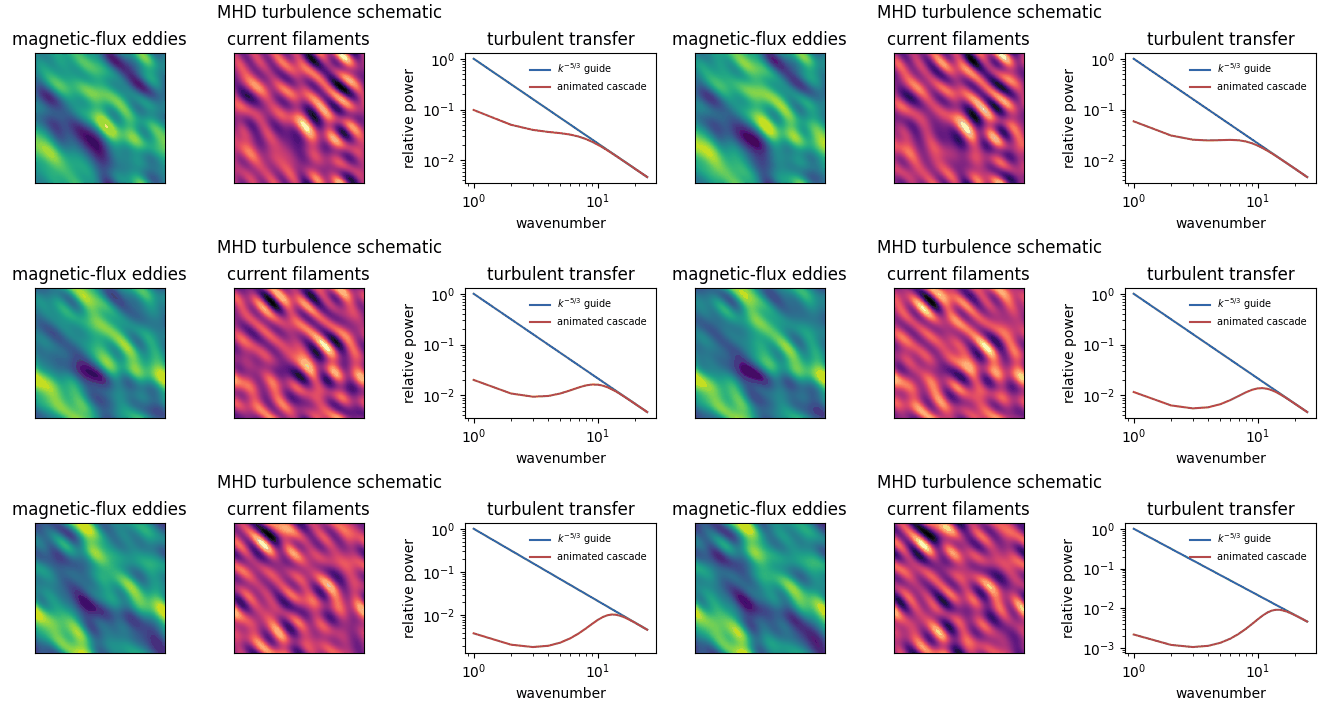
Synthetic magnetic-flux eddies, current filaments, and an animated cascade guide. |
Theory/pedagogy schematic only; not a nonlinear MHX turbulence simulation. |
|
Historical committed validation replay at |
Validation bridge from Harris tearing to longer nonlinear campaigns; bounded evidence, not converged Rutherford/plasmoid production. |
|
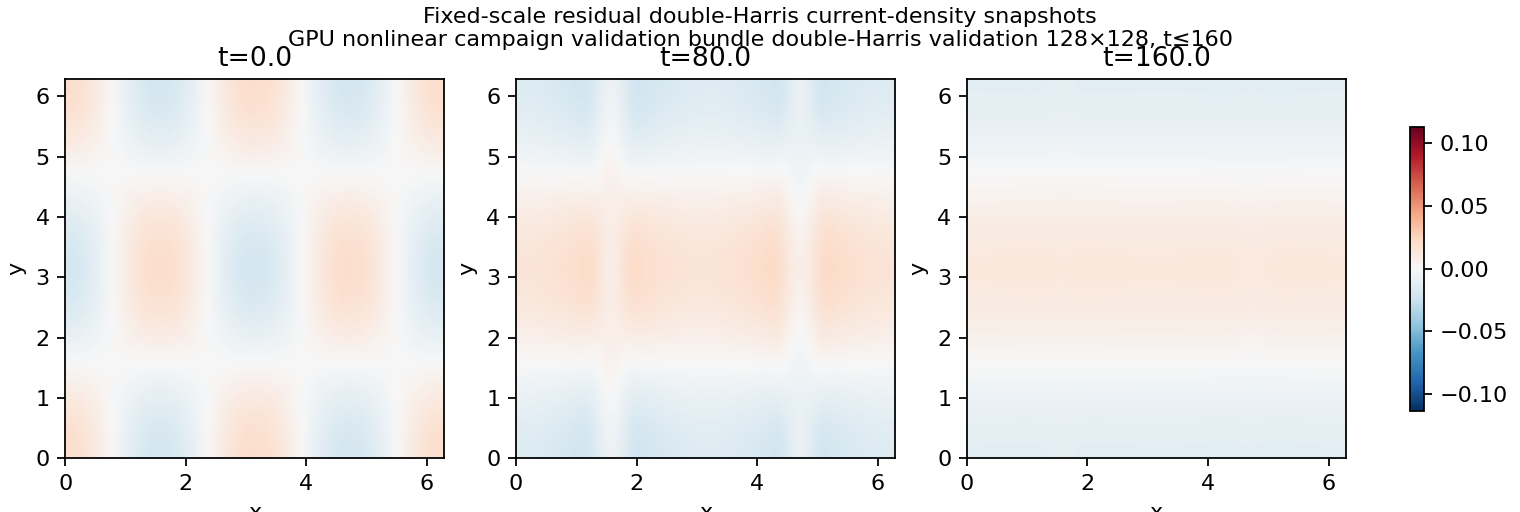
Same seeded run through fixed-scale out-of-plane current density. |
Checks current-density visualization and dissipative nonlinear replay before aspect-ratio, seed, and resolution sweeps. |
|
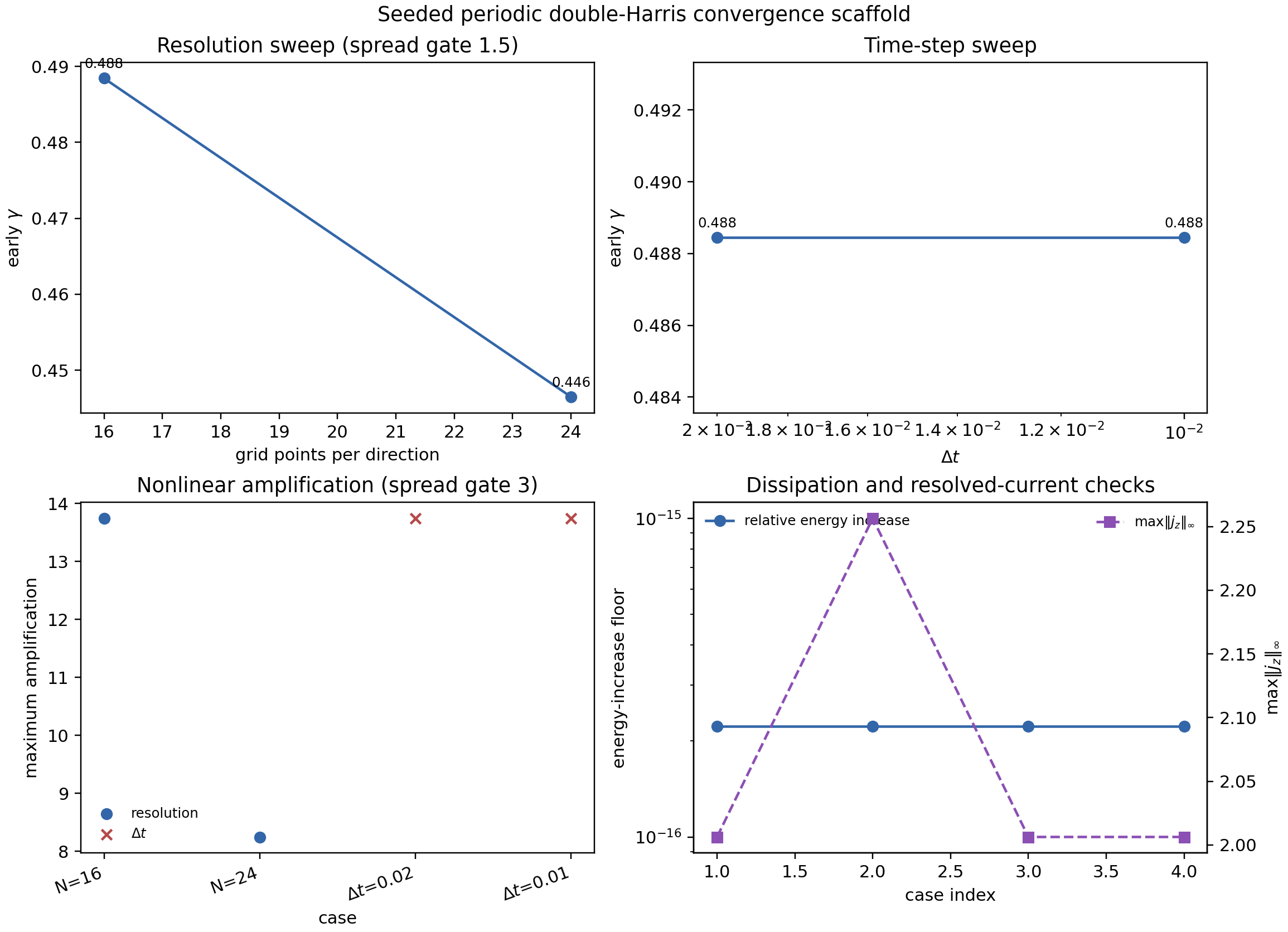
FAST resolution/time-step sweep for the seeded periodic double-Harris replay. |
Convergence scaffold that gates spread in early growth/amplification before any production Rutherford/plasmoid claim. |
|
Restartable Rutherford executor chunk with fixed-scale magnetic flux. |
Execution-path validation for the chunked production runner; not completed nonlinear production evidence. |
|
Same executor chunk through current density, using fixed color limits. |
Checks the movie/artifact lane and the current-density visualization contract. |


Still validation figures live on the physics validation, long-run evidence, and publication checklist pages where they can be interpreted with equations, tolerances, and source links.
README Harris-sheet reconnection previews
The README Harris pair is regenerated from the preferred GPU validation bundle
when present, then from the longest available seeded periodic double-Harris
history under outputs/readme_media/, outputs/long_runs/,
outputs/docs_validation/, or outputs/ci/. The current release media were
regenerated from
outputs/campaigns/gpu_nonlinear_20260522_085049/double_harris_long_n128_t160,
a 128×128, t_end=160 validation bundle chosen for visible residual
response rather than production convergence:
RUN_DIR=outputs/campaigns/gpu_nonlinear_20260522_085049

mhx benchmark double-harris-long-run \
  --outdir "$RUN_DIR/double_harris_long_n128_t160" \
  --nx 128 --ny 128 --width 0.36 --eta 0.0045 --nu 0.0045 \
  --perturbation-amplitude 0.004 --mode-x 2 --mode-y 1 \
  --dt 0.02 --t-end 160 --save-every 100 \
  --fit-start 0 --fit-stop 16 \
  --min-early-growth-rate 1e-9 \
  --min-max-growth-factor 1.000000001 \
  --min-reconnected-flux-amplification 1.000000001 \
  --min-island-width-amplification 1.000000001 \
  --movies

python examples/make_readme_media.py
The underlying periodic double-Harris field is the spectral analogue of a Harris sheet:
with a tearing-like seed
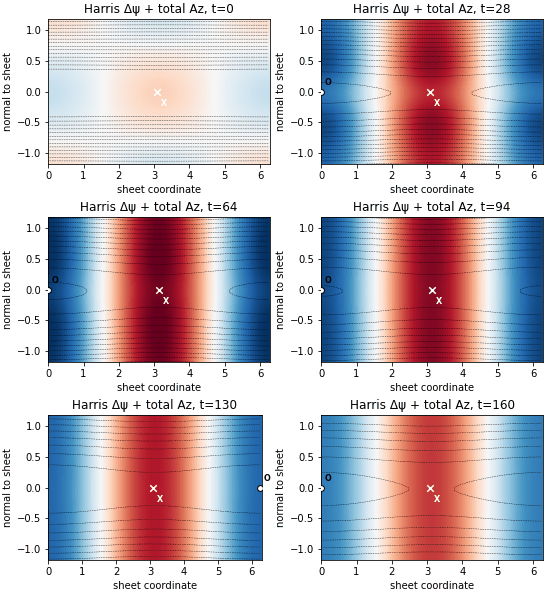
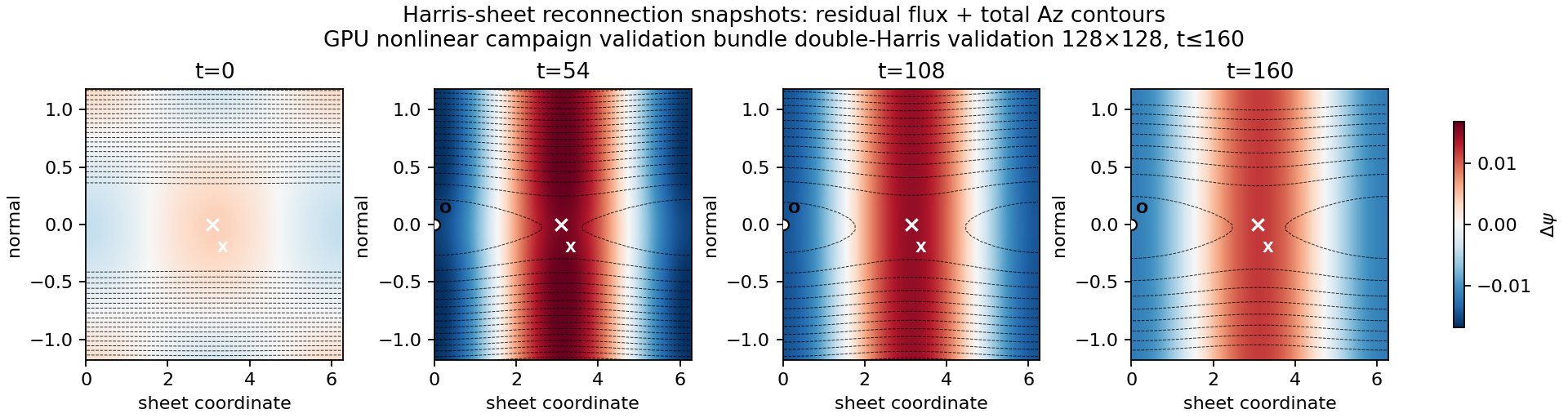
The single-sheet README movie uses residual reconnecting flux
\(\Delta\psi=\psi_\mathrm{perturbed}-\psi_\mathrm{base}\) as the color field and
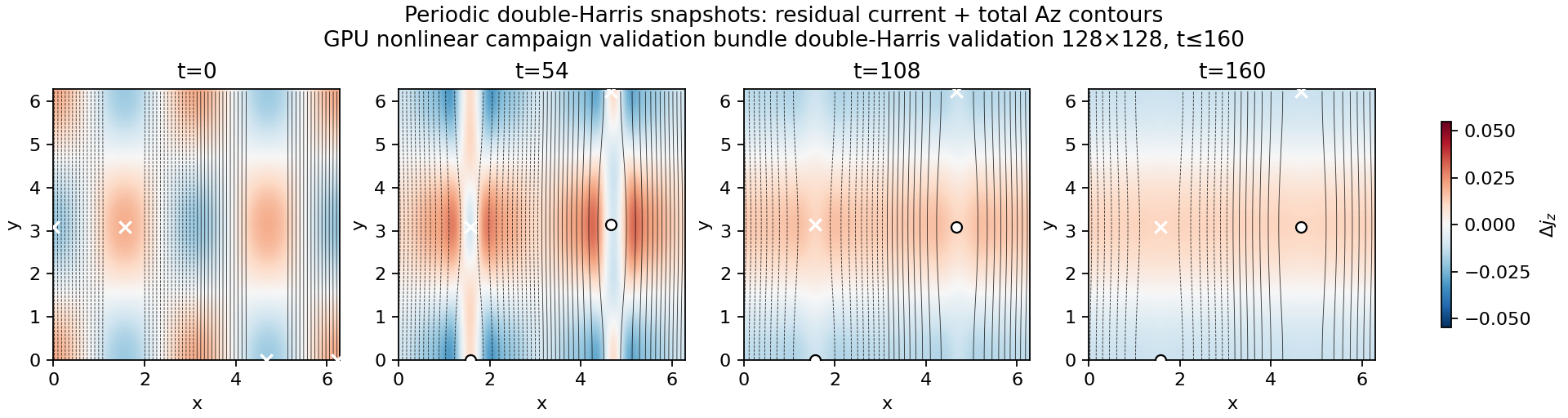
overlays total magnetic-flux (Az/ψ) contours. The full-domain companion
uses residual current \(\Delta j_z=-\nabla^2\Delta\psi\) with the same total-flux
contour context. The single-sheet movie rotates the view into standard
current-sheet coordinates: horizontal is the sheet direction and vertical is the
normal coordinate. The X/O labels are generated by the MHX
critical-point detector: local minima of \(|\nabla\psi|\) are classified by the
Hessian determinant, with saddle points marked as X and elliptic extrema
marked as O. The detector now supports sub-cell quadratic Newton refinement
for smooth fields; README labels remain diagnostic annotations rather than
claimed separatrix topology.
This media is literature-anchored to the Harris equilibrium
(Harris 1962) and the classical tearing
instability picture
(Furth, Killeen & Rosenbluth 1963).
The validation manifest confirms finite histories, positive early perturbation
growth, visible nonlinear amplification, response amplification, X/O counts,
and dissipative total energy. mhx benchmark double-harris-promotion-check
now marks the boundary between single-run media and convergence-backed
validation evidence. It remains claim_level = "validation" until broader
seed, aspect-ratio, Lundquist-number, and duration sweeps are attached.
When the same data are used for reviewer/publication media, include the
residual flux \(\psi_\mathrm{perturbed}-\psi_\mathrm{base}\) or the
reconnected-flux proxy next to these raw total-field movies; raw total flux is
not sufficient by itself because the equilibrium sheet can visually mask the
seeded response.
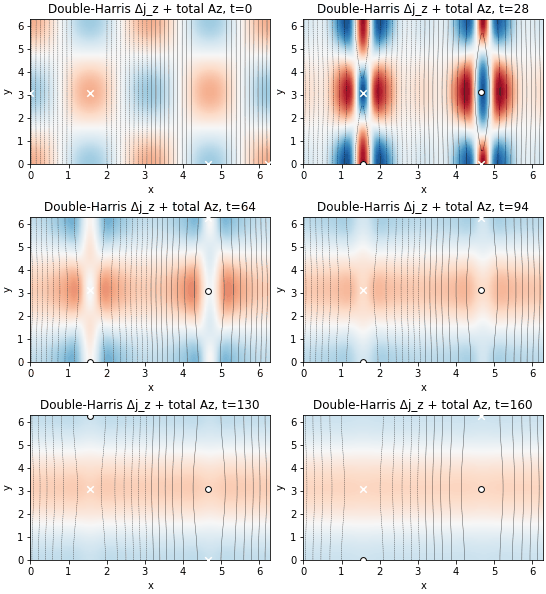
Visual QA artifacts are written next to the README movies:
docs/_static/readme/readme_media_visual_qa.jsondocs/_static/readme/double_harris_flux_snapshots.pngdocs/_static/readme/double_harris_current_snapshots.pngdocs/_static/readme/double_harris_current_sheet_snapshots.png
Source links:
Decaying and forced MHD turbulence
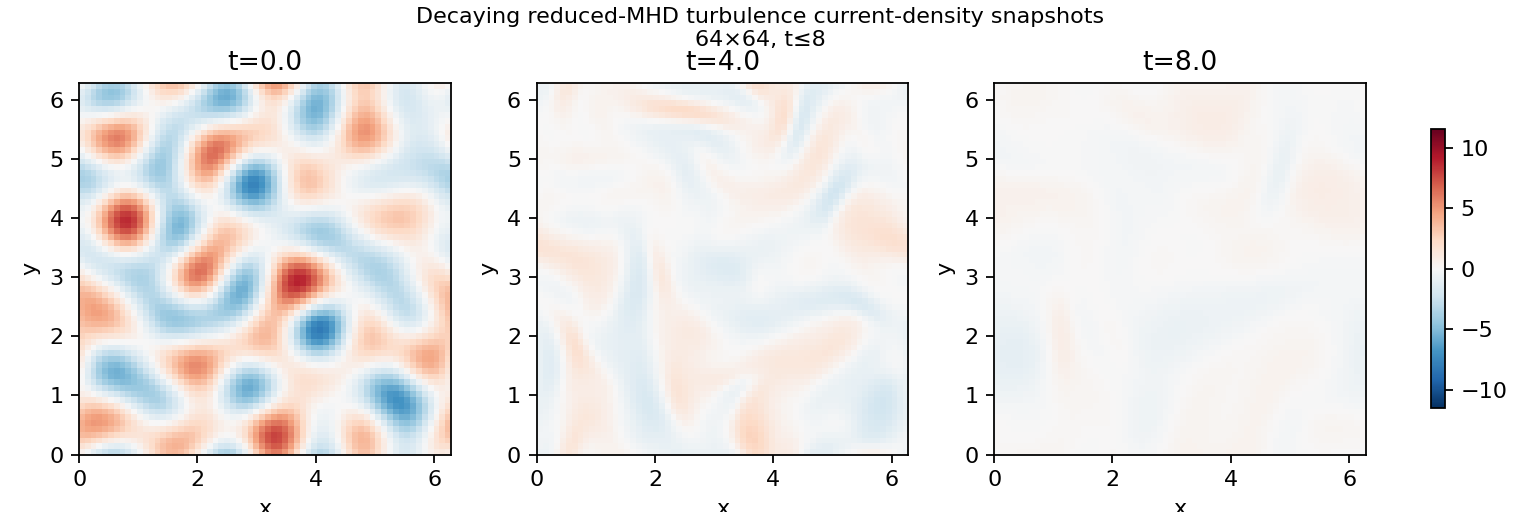
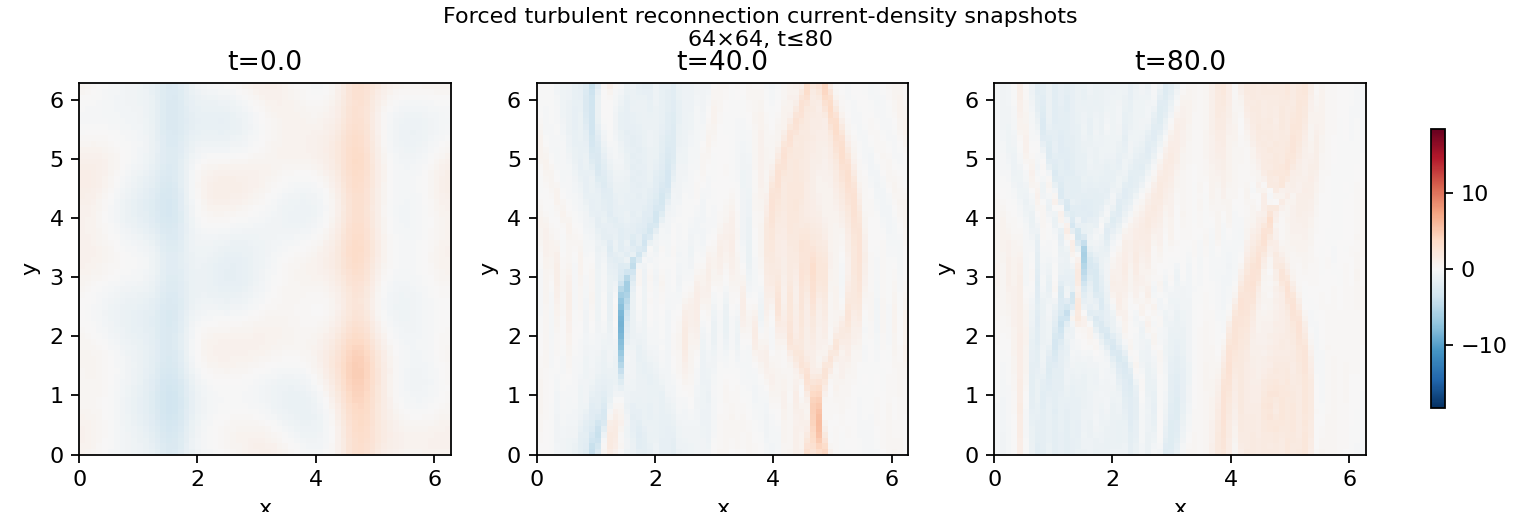
The README now includes two solver-generated turbulence examples. They are designed to be pedagogical, deterministic, and cheap enough to regenerate, not to replace high-Re turbulence production campaigns.
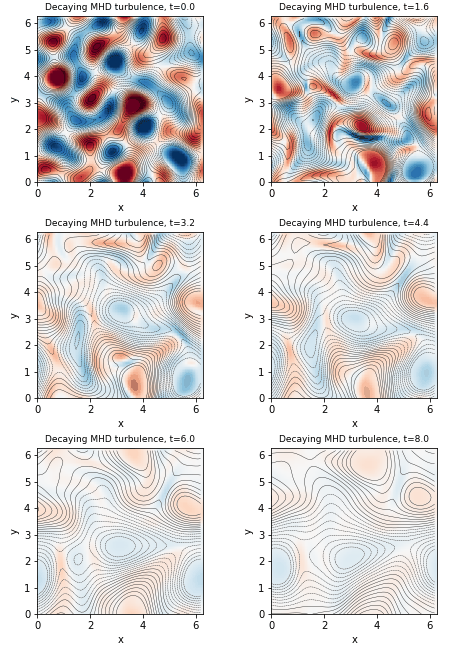
The decaying case starts from a band-limited broadband reduced-MHD state,
with an analogous stream function for the initial flow. It then evolves the standard resistive-viscous reduced-MHD equations and checks finite histories, dissipative total energy, current-sheet activity, high-wavenumber transfer, and \(\nabla\cdot\mathbf{B}_\perp=0\).
The forced current-sheet case adds the same kind of deterministic broadband flow/flux perturbation to a periodic double-Harris sheet and applies a static large-scale vorticity forcing. It records a reconnection proxy based on the absolute detected X/O flux separation, \(|\langle\psi_O\rangle-\langle\psi_X\rangle|\), and its finite-difference time derivative. This is anchored to 2-D turbulent reconnection diagnostics such as Servidio et al. 2009 and to the broader turbulent-reconnection program of Lazarian & Vishniac 1999 and Kowal et al. 2009, but MHX does not claim a 3-D LV99 fast-reconnection result from this 2-D validation example.
mhx benchmark decaying-turbulence \
  --outdir outputs/readme_media/decaying_mhd_turbulence_64_t8 \
  --nx 64 --ny 64 --eta 2e-2 --nu 2e-2 \
  --dt 1e-2 --t-end 8 --save-every 40

mhx benchmark forced-turbulent-reconnection \
  --outdir outputs/readme_media/forced_turbulent_reconnection_64_t80_wide \
  --nx 64 --ny 64 --width 0.35 --eta 1e-3 --nu 1e-3 \
  --perturbation-amplitude 1e-1 \
  --turbulent-flux-amplitude 1e-1 \
  --turbulent-flow-amplitude 1e-1 \
  --forcing-amplitude 2e-2 \
  --dt 2e-2 --t-end 80 --save-every 100 \
  --max-relative-energy-growth 30.0

python examples/make_readme_media.py
Source links:
Orszag–Tang nonlinear reduced-MHD vortex
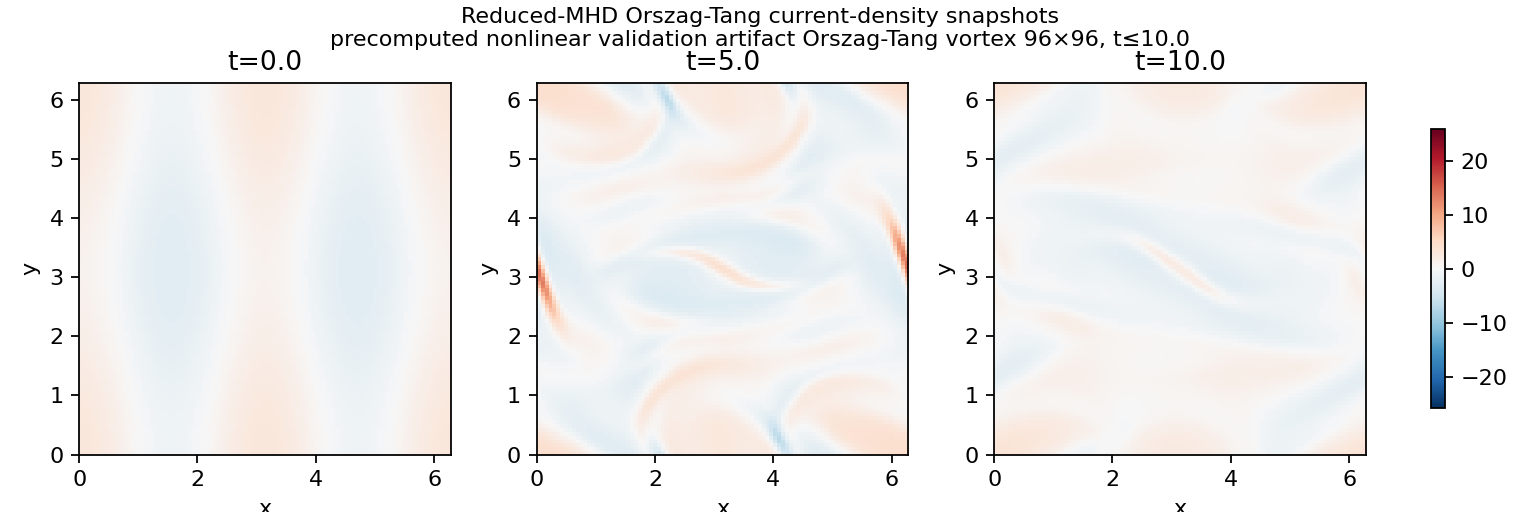
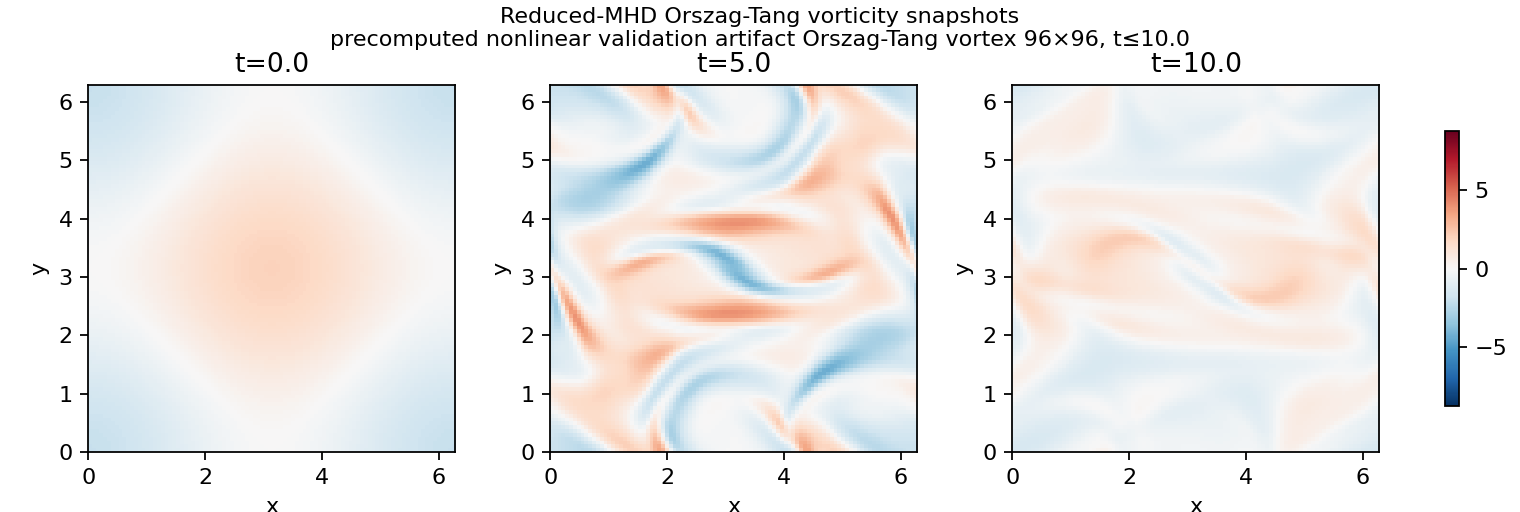
The README now includes a second nonlinear solver-generated example: an incompressible reduced-MHD adaptation of the Orszag–Tang vortex. The classic test was introduced for two-dimensional MHD turbulence by Orszag & Tang 1979 and is widely used as an MHD-code stress test; full compressible variants develop shocks, while MHX currently uses the reduced-MHD periodic vortex to exercise nonlinear advection, magnetic tension, dissipation, current-density diagnostics, and movie generation.
MHX uses
so that, with the MHX convention \(\mathbf{v}_\perp=(\partial_y\phi,-\partial_x\phi)\) and \(\mathbf{B}_\perp=(\partial_y\psi,-\partial_x\psi)\),
The committed README media were regenerated from a 96×96, t_end=10 run:
mhx benchmark orszag-tang \
  --outdir outputs/readme_media/orszag_tang_vortex_96_t10 \
  --nx 96 --ny 96 --t-end 10 --save-every 40 --movies

python examples/make_readme_media.py
The validation gates check finite arrays, monotone resistive-viscous energy decay, nonzero net dissipation, growth of current/vorticity high-wavenumber fractions, and preservation of \(\nabla\cdot\mathbf{B}_\perp=0\) by construction. The QA manifest records the peak high-wavenumber fractions and energy drop.
Source links:
Harris tearing layer sweep
This GIF is generated from mhx benchmark linear-tearing-layer. It uses the
direct finite-domain Harris-sheet eigenproblem and shows the FAST validation
trend: increasing Lundquist number reduces the growth rate and narrows the
localized flow/current response near the resonant surface. The anchor is the
classical tearing-mode picture from Furth, Killeen & Rosenbluth and the
reduced-MHD Harris eigenproblem used in the MacTaggart validation papers.
Source links:
Sweet-Parker plasmoid scaling schematic
This GIF is an explicitly labeled theory schematic, not a nonlinear MHX solver result. It visualizes the Loureiro-Schekochihin-Cowley Sweet-Parker plasmoid scalings
The purpose is pedagogic: readers should immediately see the literature target that future nonlinear MHX plasmoid runs must recover.
Source links:
MHD turbulence cascade schematic
This GIF is explicitly schematic. It combines synthetic magnetic-flux eddies, current filaments, and a \(k^{-5/3}\) guide curve to communicate the kind of turbulent MHD morphology future high-Re campaigns should target. The exponent is used as a recognizable inertial-range guide, not as a validation result. Classical reference points include Kraichnan 1958, the Iroshnikov–Kraichnan phenomenology summarized in Verma 2004, and anisotropic strong-MHD-turbulence ideas associated with Goldreich–Sridhar as discussed in modern reviews such as Schekochihin 2009.
Nonlinear validation movies
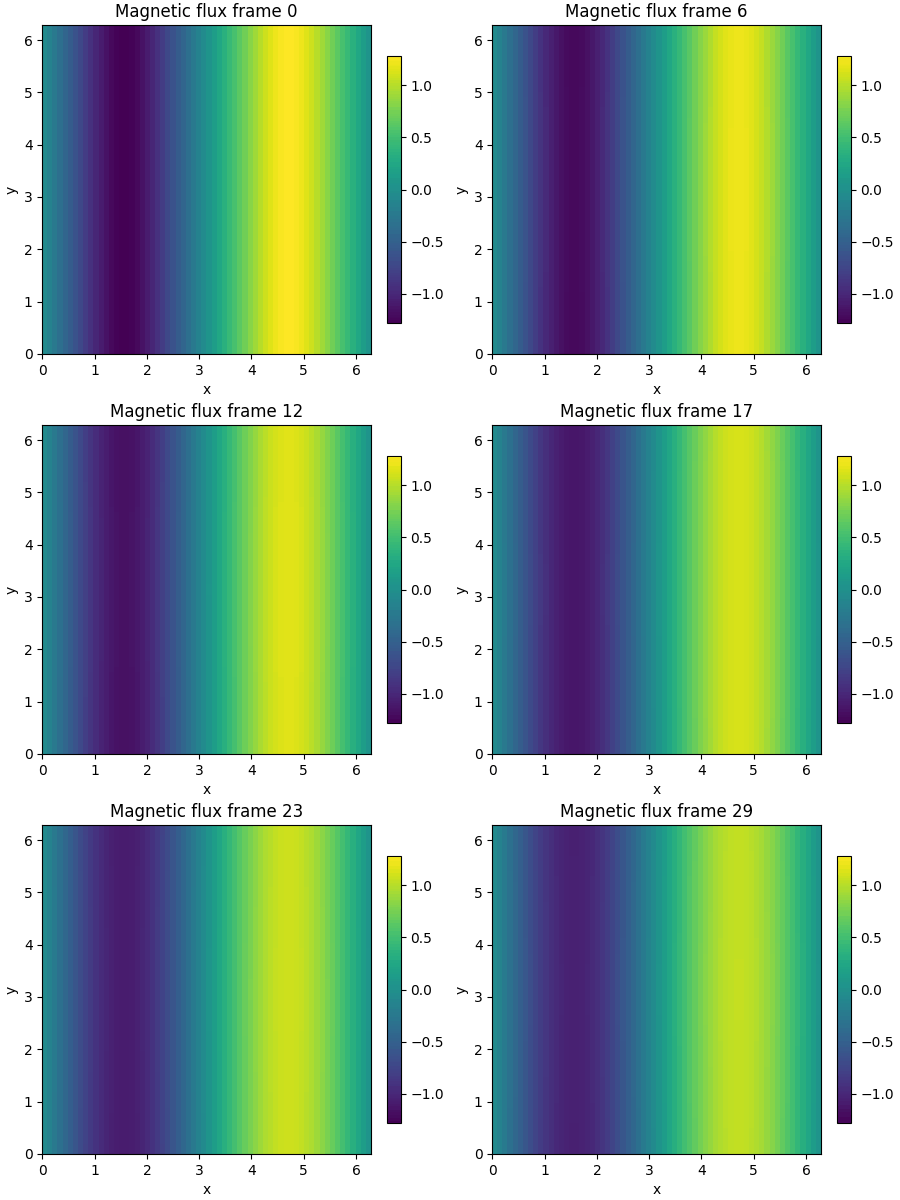
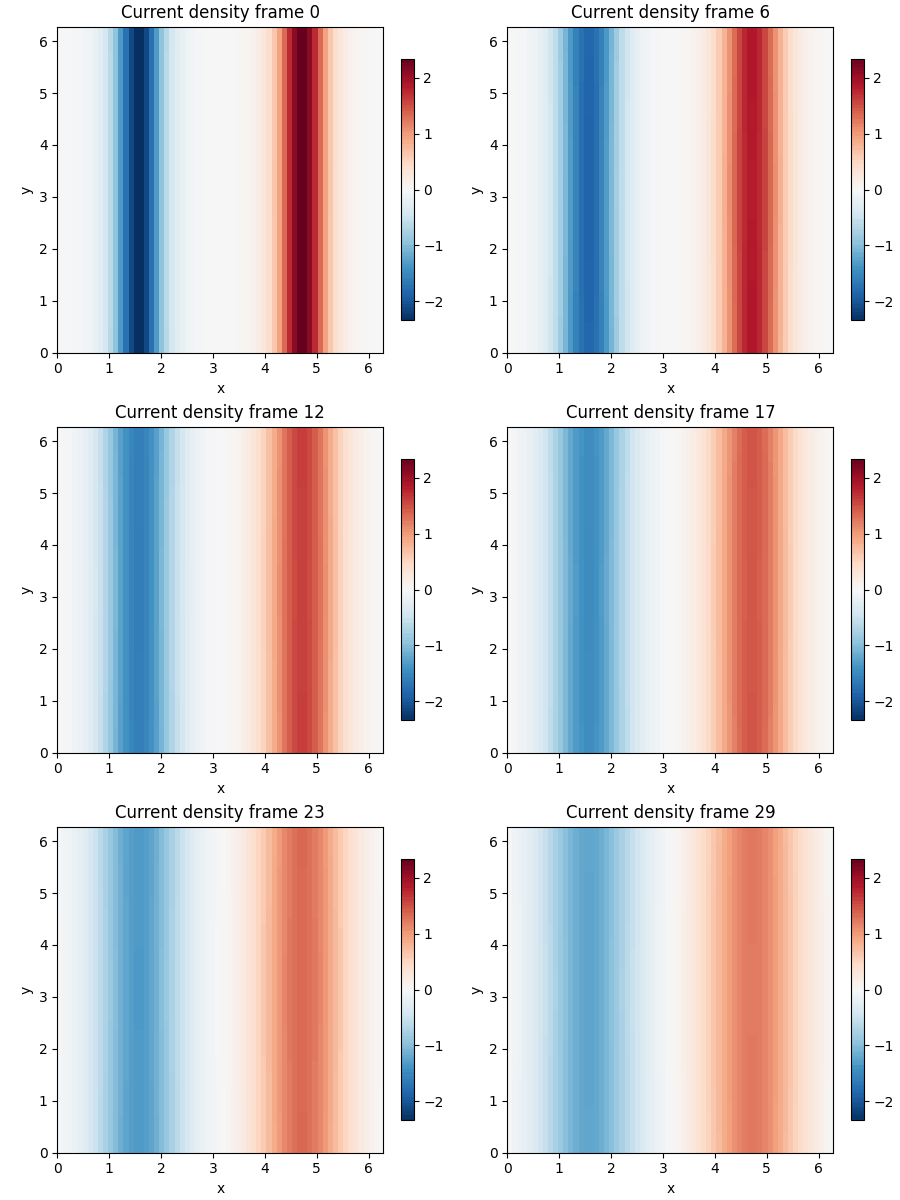
The periodic double-Harris long-run movie pair is generated by:
mhx benchmark double-harris-long-run \
  --outdir outputs/benchmarks/periodic_double_harris_seeded_long_run \
  --nx 96 --ny 96 --t-end 120 --save-every 300 --fit-stop 10 --movies
It visualizes the validation bridge documented in
physics validation.
The run advances a base periodic double-Harris sheet and a seeded copy, then
tracks normalized perturbation growth, total energy, kinetic energy, peak
current, and current-density frames. It remains claim_level = "validation"
until convergence, seed, aspect-ratio, and duration sweeps are attached.
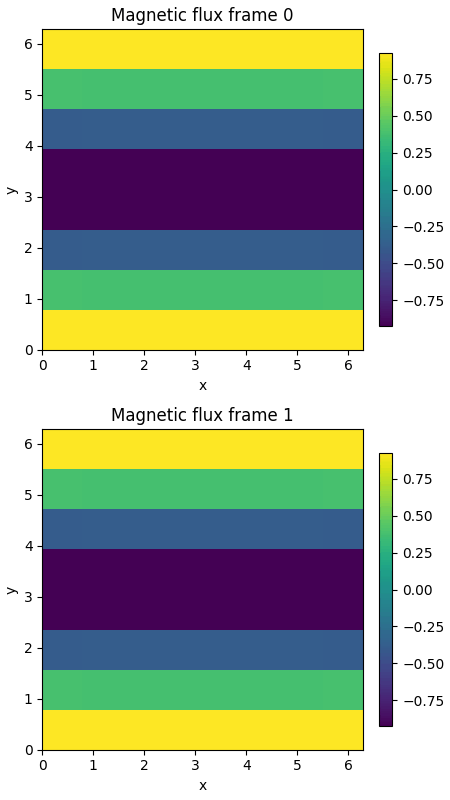
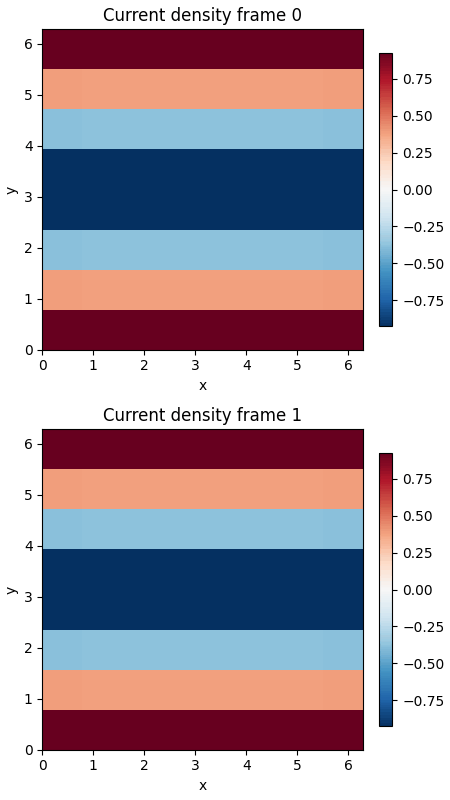
The restartable Rutherford executor movie pair is generated by:
mhx campaign rutherford-execute \
  outputs/campaigns/rutherford_production_plan \
  --max-steps 128 --movies
It validates fixed-scale flux/current movie writing, checkpoint metadata, and
manifested artifacts for a production executor chunk. A chunk or completed
duration run remains validation-level unless --allow-production-claim is used
after the planned duration completes, execution checks pass, and
mhx campaign rutherford-promotion-check writes a passing promotion-readiness
report with convergence, seed-QI, movie, geometry, energy-budget, divergence,
and X/O-count evidence.
Source links:
Latest GPU validation media status
The latest bounded GPU validation bundle is
outputs/campaigns/gpu_nonlinear_20260522_085049/double_harris_long_n128_t160.
Its raw fixed-scale flux/current movies and residual-flux audit movie are:
figures/periodic_double_harris_flux.giffigures/periodic_double_harris_current.giffigures/gpu_long_delta_flux_validation.gif
The local promotion gate summary reports gate_ready = true and
production_claim_ready = false. The passed gates cover duration, one
64/96/128 convergence bundle, X/O counts, reconnecting-flux amplification,
island-width amplification, fixed-scale movies, and manifests. It remains
validation media because the attached promotion report declares
claim_level_if_passed = "validation", not production.
Recreate the local gate summary without asserting a production claim:
python tools/nonlinear_campaign_evidence.py \
  --campaign-dir outputs/campaigns/gpu_nonlinear_20260522_085049/double_harris_long_n128_t160 \
  --output-json outputs/campaigns/gpu_nonlinear_20260522_085049/double_harris_long_n128_t160/promotion_gate_summary.json \
  --output-md outputs/campaigns/gpu_nonlinear_20260522_085049/double_harris_long_n128_t160/promotion_gate_summary.md
Regenerate the README teaser movies with:
python examples/make_readme_media.py
The generated files are intentionally compact:
docs/_static/readme/double_harris_reconnection.gifdocs/_static/readme/double_harris_current_sheet.gifdocs/_static/readme/forced_turbulent_reconnection.gifdocs/_static/readme/decaying_mhd_turbulence_current.gifdocs/_static/readme/orszag_tang_current.gifdocs/_static/readme/orszag_tang_vorticity.gifdocs/_static/readme/orszag_tang_flux.gifdocs/_static/readme/harris_layer_sweep.gifdocs/_static/readme/plasmoid_scaling_schematic.gifdocs/_static/readme/mhd_turbulence_cascade.gif