Paper plan and claim boundaries
This page is the working blueprint for a complete MHX methods/validation paper. It is intentionally conservative: it separates claims already supported by CI artifacts from nonlinear reconnection claims that still require long production runs.
Proposed paper title
MHX: a validation-first differentiable reduced-MHD framework for magnetic reconnection, physics plugins, and neural surrogate experiments
Core contributions
A pure-JAX reduced-MHD solver stack with explicit spectral operators, deterministic fixed-step integration, x64 validation gates, and artifact schemas.
A public diagnostics API with shared definitions for energy, Fourier-mode growth, divergence error, reconnecting-flux amplitude, and Rutherford-style island-width proxies.
Literature-anchored tearing/reconnection benchmarks: exact resistive decay, FKR regime formulas, Harris \(\Delta'\) matching, direct Harris eigenvalues, finite-domain dispersion, eigenfunction-layer localization, and time-domain eigenmode replay.
A physics-plugin interface for Hall, hyper-resistive, anisotropic-pressure, two-fluid, and local user-defined terms without changing solver internals.
Differentiability gates for nonlinear trajectory maps, establishing the local tangent checks required before inverse-design or neural-ODE claims.
A reproducible paper pipeline with figures, GIFs, manifests, checksums, and CI artifact validation.
Current claim status
Claim |
Current status |
Required before paper claim |
|---|---|---|
Spectral derivative signs and diffusion rates |
Supported by exact Fourier tests and exact-decay benchmark. |
Maintain x64 regression gates. |
Linear tearing eigenvalue at one Harris reference case |
Supported against the \(S=1000\), \(ka=0.5\) benchmark value \(\gamma\simeq0.0131\). |
Add medium-grid reproducibility run and artifact hash bundle. |
Finite-domain tearing dispersion branch |
Supported as a small sampled branch/residual gate. |
Extend to a documented FKR/Coppi parameter sweep. |
Nonlinear reduced-MHD budget |
Supported for a periodic multi-mode state. |
Add longer current-sheet runs with same budget diagnostics. |
Rutherford island growth |
Not yet supported. |
Run long enough for many linear e-folds, then track \(W(t)\) and compare algebraic growth. |
Sweet-Parker/plasmoid chains |
Not yet supported. |
Resolve long thin sheets and secondary islands at adequate Lundquist number. |
Neural ODE surrogate for reconnection metrics |
Deterministic FAST dataset/split/baseline/calibration artifacts plus a latent-ODE fit bundle are implemented. |
Extend the fixed dataset to medium/production trajectories and demonstrate out-of-distribution failure modes quantitatively. |
New large-push lanes
Three validation lanes have been added with explicit claim boundaries:
Lane |
Current status |
Source-code boundary |
|---|---|---|
|
Implemented as FAST seed-ensemble validation for smooth perturbation sensitivity. It is not production UQ. |
QI implementation lives in seed_robust_qi.py; deterministic initial conditions remain in equilibria.py. |
FAST Rutherford campaign runner and restartable executor |
Implemented for validation-grade histories, schema checks, production-template writing, restartable chunks, and a promotion checker. Existing duration-complete runs are not promoted unless the response, convergence, seed-QI, geometry, movie, energy, and divergence gates all pass. |
Template writing lives in campaigns.py; FAST runner lives in campaign_runner.py; production execution and promotion live in production.py. |
|
Implemented as deterministic FAST dataset, train/validation/test splits, no-training baselines, residual calibration, and a latent-ODE fit. It is not yet a production surrogate claim. |
Dataset, baseline, and latent-ODE implementation lives in reproducibility.py. |
Both lanes are exposed through the CLI in main.py.
The production operations guide now exists as campaign_runner.md. It documents the FAST runner, production plan, duration gate, checkpoint/resume metadata, required production artifacts, restartable executor chunks, and review questions. Paper text should still say “FAST campaign validation”, “duration-complete validation bundle”, or “production executor chunk” rather than “production campaign result” until the long-run bundle also has passing convergence, seed-QI, geometry, X/O, and promotion evidence.
Nonlinear duration requirement
For a linear eigenmode with growth rate \(\gamma\), observing \(N_e\) e-folds requires
The direct Harris benchmark used by MHX has \(\gamma\simeq0.0131\) at \(S=1000\), \(ka=0.5\). Ten e-folds therefore require
The default FAST nonlinear energy-budget gate runs to \(t=0.8\), which is only about \(1.0\times 10^{-3}\) of this ten-e-fold window. Longer validation runs now exercise the same gates, but they remain code-validity evidence until paired with convergence and seed-QI promotion bundles.
mhx benchmark nonlinear-duration-audit \
  --outdir outputs/benchmarks/nonlinear_duration_audit
mhx benchmark duration-policy \
  --outdir outputs/benchmarks/duration_policy
mhx campaign rutherford-template \
  --outdir outputs/campaigns/rutherford_template
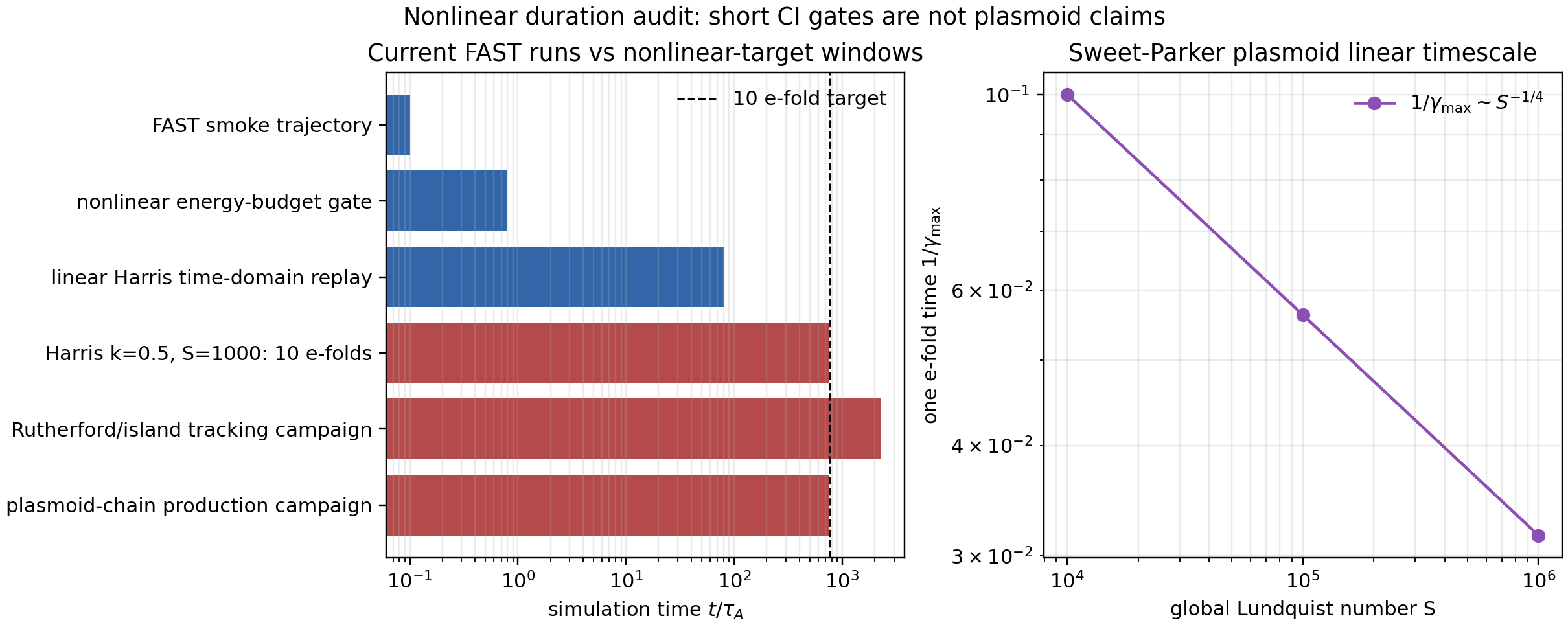
Proposed figure set
Figure |
Contents |
Status |
|---|---|---|
1 |
Architecture: configs → model registry → solver → diagnostics → artifacts. |
Draft in docs/architecture. |
2 |
Exact decay and spectral-operator identities. |
CI artifact exists. |
3 |
FKR, plasmoid, and ideal-tearing analytic scaling targets. |
CI artifact exists; analytic only. |
4 |
Harris \(\Delta'\) and direct eigenvalue benchmark. |
CI artifact exists. |
5 |
Finite-domain dispersion and eigenfunction layer localization. |
CI artifact exists. |
6 |
Time-domain eigenmode replay and growth-fit recovery. |
CI artifact exists. |
7 |
Nonlinear differentiability and energy-budget gates. |
CI artifact exists. |
8 |
Nonlinear duration audit and production-run requirements. |
CI artifact exists. |
9 |
Rutherford island growth campaign. |
|
10 |
Sweet-Parker/plasmoid nonlinear campaign. |
Planned. |
11 |
Neural-ODE dataset/baselines/calibration/failure cases. |
Implemented as a deterministic no-training reproducibility lane in neural_ode_reproducibility.md. |
The reviewer-facing figure readiness table is maintained in publication_checklist.md. That page is the preferred place to decide whether a plot can be promoted from validation/demo status to paper evidence.
Reproducible paper pipeline
The paper artifact lane is deliberately stricter than docs rendering. A figure
is not considered reviewer-ready unless docs/figures/manifest.toml records
its regeneration command, claim level, claim scope, source files, tests, and
SHA-256 checksum. Before a paper or validation bundle is handed to a reviewer,
run:
python examples/tools/verify_paper_artifacts.py \
  --artifact-root docs/_static/validation
This verifier checks the documentation figure manifest, recomputes figure
hashes, verifies source/test paths, and validates any recursive
artifact_manifest.json files under the requested artifact root. A passing
paper-pipeline check means the artifact is traceable and hash-stable; it does
not upgrade a validation result to production. Production claims still
require the long-run duration, convergence, seed-QI, geometry, response,
energy, divergence, fixed-scale movie, and promotion-readiness gates listed
below.
Production nonlinear campaign checklist
Every nonlinear island/plasmoid result should archive:
full config, code commit, API version, dependency lock file, and manifest;
a passing duration-policy check for the declared growth rate and e-fold count;
x64 setting and JIT setting;
grid, timestep, CFL or fixed-step stability rationale, and tolerances;
reconnected flux \(\psi_1(t)\) and island width \(W=4\sqrt{|\psi_1|/|B_y'(0)|}\);
peak/initial amplification of reconnecting flux and island width above the declared promotion thresholds;
reconnection proxy \(E_\mathrm{rec}\), current-sheet length/thickness, and aspect ratio;
magnetic, kinetic, total energy, resistive dissipation, viscous dissipation, and budget residual;
at least one resolution/time-step comparison;
visual flux/current movies with fixed color ranges;
explicit claim boundary: smoke, validation, or production physics result.
generated
claim_levelmetadata in every manifest and artifact manifest.
Literature anchors
Furth, Killeen & Rosenbluth (1963) for constant-\(\psi\) tearing theory.
Rutherford (1973) for nonlinear tearing/island growth.
Loureiro, Schekochihin & Cowley (2007) for Sweet-Parker plasmoid instability scalings.
Pucci & Velli (2014) for ideal tearing.
MacTaggart Harris benchmark PDF for the direct Harris-sheet eigenvalue anchor used in MHX.